
You are typing a quick message and stop mid-sentence. Is it “I say it yesterday” or “I said it yesterday”? One tiny word, and the whole line feels off. That doubt around say vs said trips up beginners and fluent speakers alike, and a wrong pick can make a message look careless. The good news: the rule is short. Once you know which word points to the past, you will choose correctly every time.
What Does “Say” Mean?
Say means to speak words out loud or put them in writing. It is one of the most common verbs in English. It appears in the present tense, in the infinitive, and after helper verbs like do, can, will, and would.
Here is how it works in practice:
- Habits: “I always say thank you.”
- After helper verbs: “Did you say something?” or “I will say it again.”
- After “to”: “I want to say sorry.”
“Say” also has a few extra jobs:
- A noun: “Everyone gets a say in the vote.”
- “For example”: “Say you have ten dollars. How many snacks can you buy?”
- An attention word: “Say, are you free tonight?”
What Does “Said” Mean?
Said is what you use when the speaking already happened. It works as the past tense (“She said no”) and as the past participle (“She has said no twice”).
Notice the spelling. Most English verbs add -ed for the past, but say does not. That makes it an irregular verb. The sound changes too: say is pronounced “SAY,” while said is pronounced “sed,” the same as the word bed.
Examples:
- “He said he was running late.”
- “I said I would call you back.”
- “They said the movie starts at eight.”
Say vs Said at a Glance
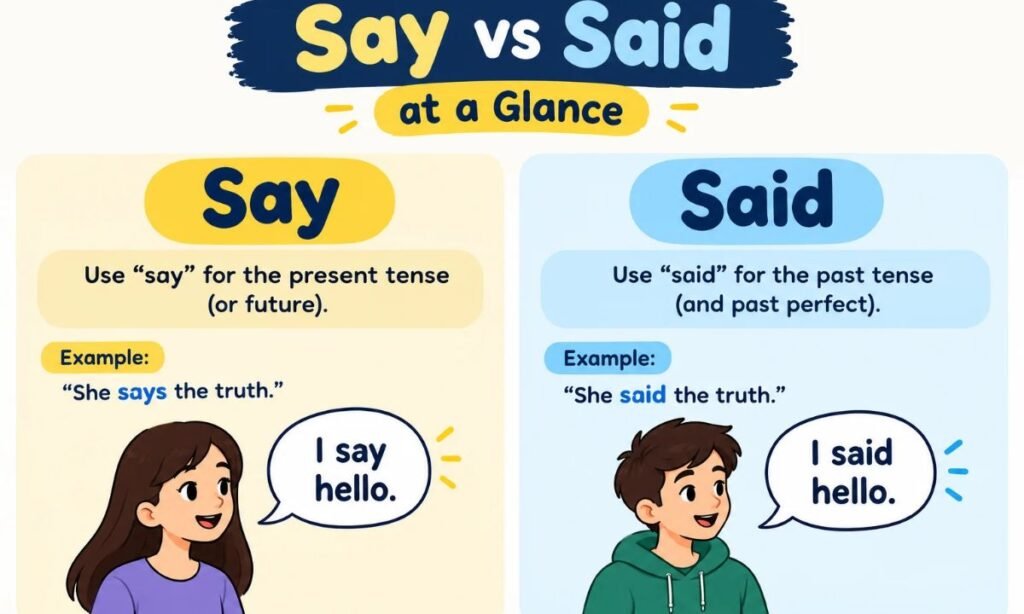
| Feature | Say | Said |
| Verb form | Base form, present tense | Past tense and past participle |
| Time | Now, always, or future | Already finished |
| Pronunciation | /seɪ/ (“SAY”) | /sɛd/ (“sed”) |
| Used after | I, you, we, they, helper verbs | Any subject, plus have, has, had |
| Example | “I say what I think.” | “I said what I thought.” |
| Third person singular | says | said (no change) |
One handy detail: said never changes by subject. “I said,” “she said,” and “they said” all use the same form.
How to Choose Between Say and Said
Run this quick three-step test before you commit to a word.
- Ask when it happened. If it is over, use said. If it is happening now, repeats often, or is a general truth, use say.
- Look for helper verbs. After do, does, did, can, will, would, should, or to, use say. After have, has, or had, use said.
- Check the time clues. Words like yesterday, last week, and earlier point to said. Words like every day, usually, now, and tomorrow point to say.
The helper verb rule matters because did already carries the past tense. Adding it twice (“Did you said?”) is a classic slip.
Say, Says, or Said? The Third Person Trap
Most confusion about “say or said” hides in the present tense. When the subject is he, she, it, or a single person or thing, the present tense becomes says.
| Subject | Present | Past |
| I | say | said |
| You | say | said |
| He / She / It | says | said |
| We / They | say | said |
Examples:
- “She says the meeting is canceled.” (right now)
- “She said the meeting was canceled.” (earlier)
- “He say hello” is wrong. It needs says.
Here is a pronunciation twist. Says is pronounced “sez,” not “sayz.” It is one of the few places where English spelling and sound drift apart.
Said With Have, Has, and Had
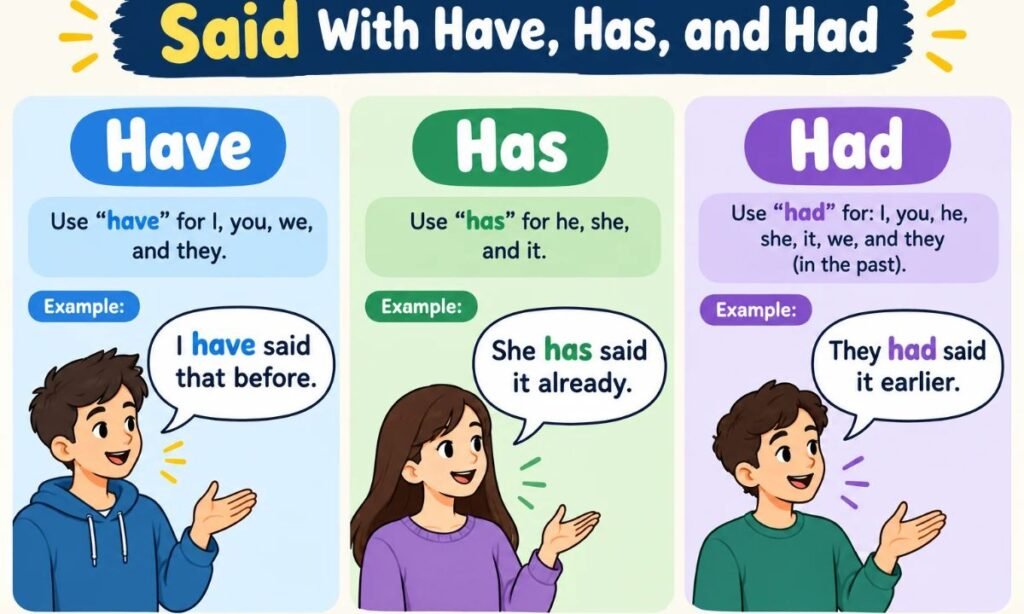
Because said is also the past participle, it pairs with have, has, and had to build perfect tenses. Many learners miss this because they think “said” belongs only to the simple past.
- Present perfect: “I have said this before.”
- Past perfect: “She had said goodbye before the bus left.”
- Passive voice: “It is said that the bridge is over 100 years old.”
You may also see said in legal writing, where it points back to something already named: “the said contract.” Everyday writing rarely uses it this way, so skip it unless you are writing legal text.
Said in Reported Speech
Reported speech retells what someone told you. The main verb usually goes to the past, so you use said, and the verb after it often shifts back a step.
| Direct speech | Reported speech |
| “I am tired.” | She said she was tired. |
| “We will win.” | They said they would win. |
| “I like pizza.” | He said he liked pizza. |
There is a useful exception. When the statement is still true, native speakers often keep the present tense: “My doctor said exercise is good for sleep.”
Also, said does not need “that” after it. Both “She said that she was late” and “She said she was late” are correct. The shorter one is more common in conversation.
Common Phrases With Say and Said
Some phrases lock the verb into one form. Learning them as chunks saves you from stopping to think.
- “Needless to say”: used before something obvious.
- “That is to say”: used to explain or rephrase.
- “Have a say”: to get a voice in a decision.
- “Goes without saying”: something everyone already knows.
- “Said and done”: finished, as in “When all is said and done, we won.”
- “Easier said than done”: harder in practice than it sounds.
- “No sooner said than done”: done right away.
Notice that “easier said than done” uses the participle, which is another reason to remember that said does double duty.
Common Mistakes With Say and Said
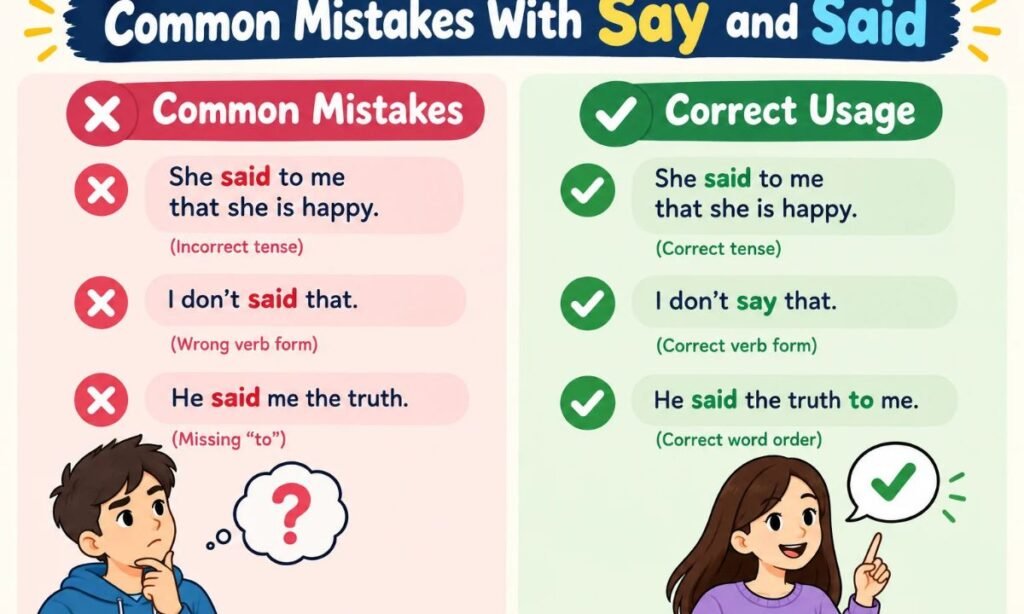
These errors come up again and again. Each one has a quick fix.
- Writing “sayed.” English does not add -ed to say. The correct past form is said.
- “He say” or “she say.” Add the -s: he says.
- “Did you said?” After did, use the base form: did you say.
- “I have say it.” Perfect tenses need the participle: I have said it.
- Mixing tenses in one story. “Yesterday, she says she was sick” jumps between present and past. Stay in the past: “Yesterday, she said she was sick.”
- “What do you said?” After do, use the base form: “What do you say?”
A quick note: Sayed is a real spelling of a name in some cultures, but it is never the past tense of the verb.
Say vs Tell vs Speak
Many learners choose the wrong verb entirely, before they even reach say vs said. Here is the simple split.
- Say focuses on the words: “She said hello.”
- Tell needs a person who hears it: “She told me the news.” You cannot tell without a listener.
- Speak is about the act or the language: “He speaks Spanish.” “Can I speak to the manager?”
Compare these pairs:
- Correct: “He said he was hungry.” Also correct: “He told me he was hungry.”
- Incorrect: “He said me he was hungry.” Say does not take a listener directly. You need “said to me.”
Their past forms are said, told, and spoke. All three are irregular.
Practice: Test Yourself
Fill in the blank with say, says, or said. Answers are below.
- Yesterday, my teacher ___ the quiz was easy.
- I ___ please and thank you every day.
- The label ___ keep refrigerated.
- Have you ___ sorry yet?
- Did she ___ where she was going?
- Last night, the weather report ___ it would rain today.
Answers: 1. said, 2. say, 3. says, 4. said, 5. say, 6. said.
For speaking practice, read each sentence out loud and listen for “sed” in the past and “say” in the present. Your ear often catches the wrong one before your eyes do.
FAQ
How do you use say and said in a sentence?
Use say when the action is current, repeated, or general: “I say what I mean.” Use said when it is finished: “I said what I meant.” In both cases, the verb matches the time of the action.
When do I use say or said?
Pick say for the present, for habits, and after helper verbs like do, can, and will. Pick said for the past and after have, has, or had. If the event is over, choose said.
Is it “you say” or “you said”?
Both are correct, and the time decides. “You say you are ready” refers to now. “You said you were ready” refers to something earlier. Use “you said” when pointing back to a past statement.
Should I use said or says?
Use says for a single third person subject in the present: “She says it is fine.” Use said for the past: “She said it was fine.” If the moment already happened, said is your word.
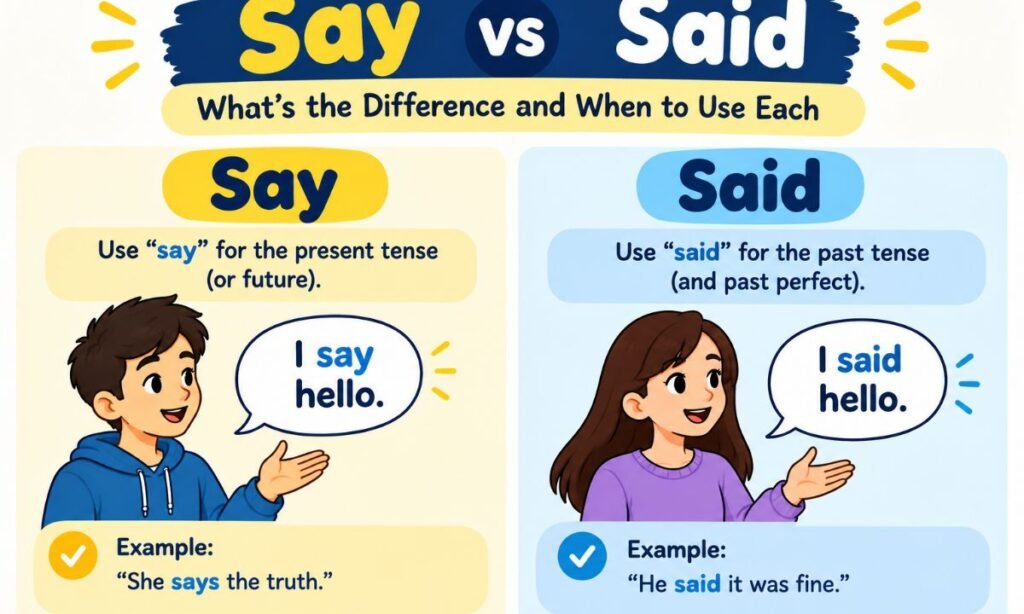
You are typing a quick message and stop mid-sentence. Is it “I say it yesterday” or “I said it yesterday”? One tiny word, and the whole line feels off.
That doubt around say vs said trips up beginners and fluent speakers alike, and a wrong pick can make a message look careless. The good news: the rule is short. Once you know which word points to the past, you will choose correctly every time.
What Does “Say” Mean?
Say means to speak words out loud or put them in writing. It is one of the most common verbs in English. It appears in the present tense, in the infinitive, and after helper verbs like do, can, will, and would.
Here is how it works in practice:
- Habits: “I always say thank you.”
- After helper verbs: “Did you say something?” or “I will say it again.”
- After “to”: “I want to say sorry.”
“Say” also has a few extra jobs:
- A noun: “Everyone gets a say in the vote.”
- “For example”: “Say you have ten dollars. How many snacks can you buy?”
- An attention word: “Say, are you free tonight?”
What Does “Said” Mean?
Said is what you use when the speaking already happened. It works as the past tense (“She said no”) and as the past participle (“She has said no twice”).
Notice the spelling. Most English verbs add -ed for the past, but say does not. That makes it an irregular verb. The sound changes too: say is pronounced “SAY,” while said is pronounced “sed,” the same as the word bed.
Examples:
- “He said he was running late.”
- “I said I would call you back.”
- “They said the movie starts at eight.”
Say vs Said at a Glance
| Feature | Say | Said |
| Verb form | Base form, present tense | Past tense and past participle |
| Time | Now, always, or future | Already finished |
| Pronunciation | /seɪ/ (“SAY”) | /sɛd/ (“sed”) |
| Used after | I, you, we, they, helper verbs | Any subject, plus have, has, had |
| Example | “I say what I think.” | “I said what I thought.” |
| Third person singular | says | said (no change) |
One handy detail: said never changes by subject. “I said,” “she said,” and “they said” all use the same form.
How to Choose Between Say and Said
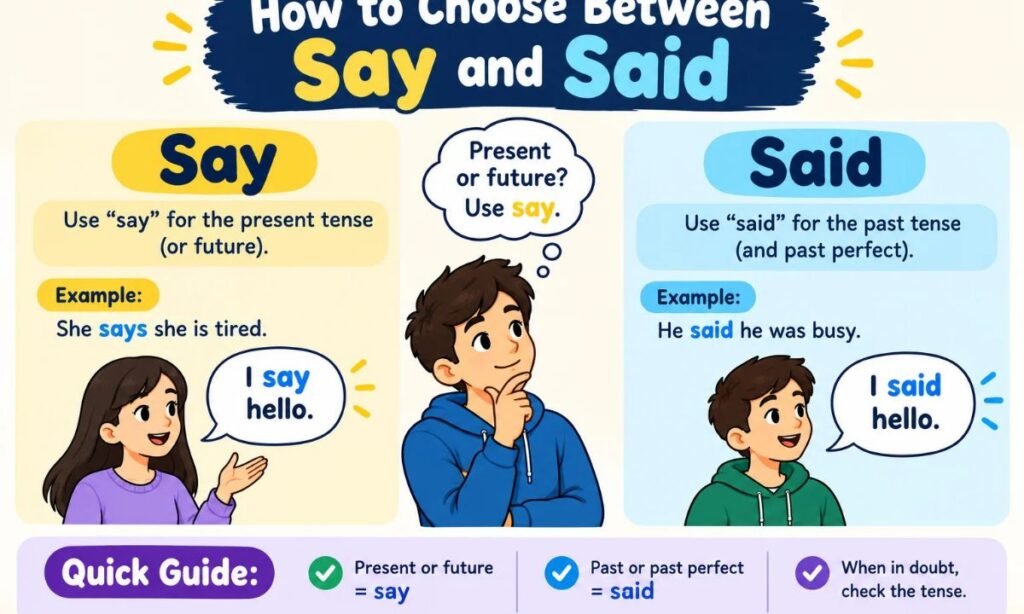
Run this quick three-step test before you commit to a word.
- Ask when it happened. If it is over, use said. If it is happening now, repeats often, or is a general truth, use say.
- Look for helper verbs. After do, does, did, can, will, would, should, or to, use say. After have, has, or had, use said.
- Check the time clues. Words like yesterday, last week, and earlier point to said. Words like every day, usually, now, and tomorrow point to say.
The helper verb rule matters because did already carries the past tense. Adding it twice (“Did you said?”) is a classic slip.
Say, Says, or Said? The Third Person Trap
Most confusion about “say or said” hides in the present tense. When the subject is he, she, it, or a single person or thing, the present tense becomes says.
| Subject | Present | Past |
| I | say | said |
| You | say | said |
| He / She / It | says | said |
| We / They | say | said |
Examples:
- “She says the meeting is canceled.” (right now)
- “She said the meeting was canceled.” (earlier)
- “He say hello” is wrong. It needs says.
Here is a pronunciation twist. Says is pronounced “sez,” not “sayz.” It is one of the few places where English spelling and sound drift apart.
Said With Have, Has, and Had
Because said is also the past participle, it pairs with have, has, and had to build perfect tenses. Many learners miss this because they think “said” belongs only to the simple past.
- Present perfect: “I have said this before.”
- Past perfect: “She had said goodbye before the bus left.”
- Passive voice: “It is said that the bridge is over 100 years old.”
You may also see said in legal writing, where it points back to something already named: “the said contract.” Everyday writing rarely uses it this way, so skip it unless you are writing legal text.
Said in Reported Speech
Reported speech retells what someone told you. The main verb usually goes to the past, so you use said, and the verb after it often shifts back a step.
| Direct speech | Reported speech |
| “I am tired.” | She said she was tired. |
| “We will win.” | They said they would win. |
| “I like pizza.” | He said he liked pizza. |
There is a useful exception. When the statement is still true, native speakers often keep the present tense: “My doctor said exercise is good for sleep.”
Also, said does not need “that” after it. Both “She said that she was late” and “She said she was late” are correct. The shorter one is more common in conversation.
Common Phrases With Say and Said
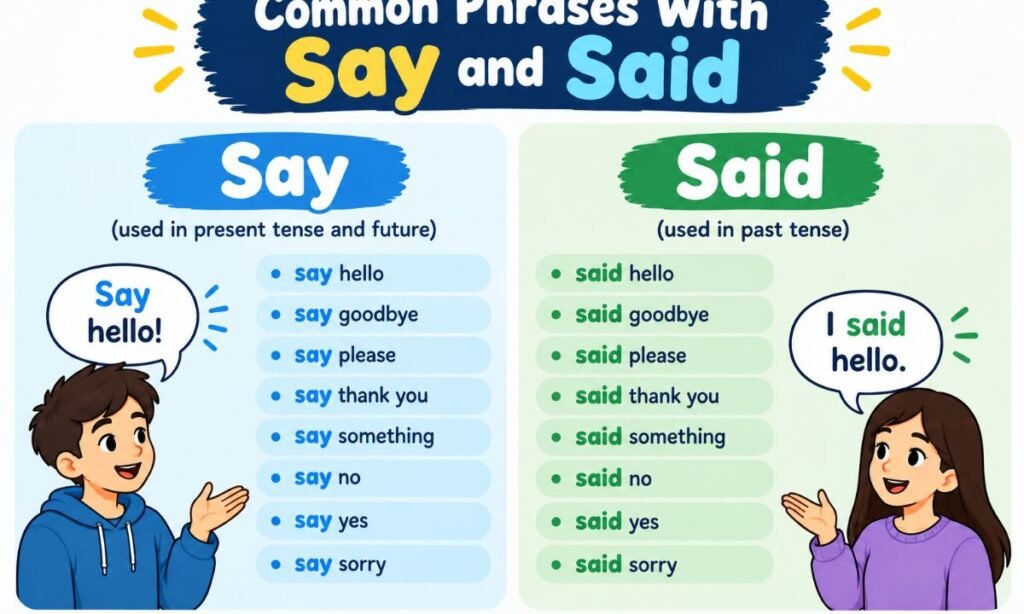
Some phrases lock the verb into one form. Learning them as chunks saves you from stopping to think.
- “Needless to say”: used before something obvious.
- “That is to say”: used to explain or rephrase.
- “Have a say”: to get a voice in a decision.
- “Goes without saying”: something everyone already knows.
- “Said and done”: finished, as in “When all is said and done, we won.”
- “Easier said than done”: harder in practice than it sounds.
- “No sooner said than done”: done right away.
Notice that “easier said than done” uses the participle, which is another reason to remember that said does double duty.
Common Mistakes With Say and Said
- Writing “sayed.” English does not add -ed to say. The correct past form is said.
- “He say” or “she say.” Add the -s: he says.
- “Did you said?” After did, use the base form: did you say.
- “I have say it.” Perfect tenses need the participle: I have said it.
- Mixing tenses in one story. “Yesterday, she says she was sick” jumps between present and past. Stay in the past: “Yesterday, she said she was sick.”
- “What do you said?” After do, use the base form: “What do you say?”
A quick note: Sayed is a real spelling of a name in some cultures, but it is never the past tense of the verb.
Say vs Tell vs Speak
Many learners choose the wrong verb entirely, before they even reach say vs said. Here is the simple split.
- Say focuses on the words: “She said hello.”
- Tell needs a person who hears it: “She told me the news.” You cannot tell without a listener.
- Speak is about the act or the language: “He speaks Spanish.” “Can I speak to the manager?”
Compare these pairs:
- Correct: “He said he was hungry.” Also correct: “He told me he was hungry.”
- Incorrect: “He said me he was hungry.” Say does not take a listener directly. You need “said to me.”
Their past forms are said, told, and spoke. All three are irregular.
Practice: Test Yourself

Fill in the blank with say, says, or said. Answers are below.
- Yesterday, my teacher ___ the quiz was easy.
- I ___ please and thank you every day.
- The label ___ keep refrigerated.
- Have you ___ sorry yet?
- Did she ___ where she was going?
- Last night, the weather report ___ it would rain today.
Answers: 1. said, 2. say, 3. says, 4. said, 5. say, 6. said.
For speaking practice, read each sentence out loud and listen for “sed” in the past and “say” in the present. Your ear often catches the wrong one before your eyes do.
Frequently Asked Questions
How do you use say and said in a sentence?
Use say when the action is current, repeated, or general: “I say what I mean.” Use said when it is finished: “I said what I meant.” In both cases, the verb matches the time of the action.
When do I use say or said?
Pick say for the present, for habits, and after helper verbs like do, can, and will. Pick said for the past and after have, has, or had. If the event is over, choose said.
Is it “you say” or “you said”?
Both are correct, and the time decides. “You say you are ready” refers to now. “You said you were ready” refers to something earlier. Use “you said” when pointing back to a past statement.
Should I use said or says?
Use says for a single third person subject in the present: “She says it is fine.” Use said for the past: “She said it was fine.” If the moment already happened, said is your word.