
You are typing a caption about your cozy Sunday, and your fingers write “ca” before you stop. Cocoon or cacoon? Both look almost right, which is exactly the problem.
One wrong letter can make a polished sentence look rushed, and spell check does not always catch it. Here is the fix: only one version exists in the dictionary, and a few simple tricks will lock it into your memory for good.
Which Spelling Is Correct?
Cocoon is correct in American English, British English, and every other major variety. It has two O’s in the middle and ends in “oon,” so the letters run C-O-C-O-O-N.
The word comes into English from French (cocon). Dictionaries list only that one spelling, so there is no regional exception and no acceptable alternate.
If you write “cacoon” in an essay, email, or product listing, a reader will see it as a typo. It will not be treated as a stylistic choice.
What Does Cocoon Mean?
Cocoon has a literal meaning and a figurative one. Knowing both makes the word easier to use correctly.
Literal meaning: A cocoon is a case of silk or similar material that an insect larva spins around itself before turning into an adult. Many moths do this. Silkworms are the best-known example, and the silk used in clothing comes from their cocoons.
Other literal uses: Some spiders wrap their eggs in a silky covering, which people often call an egg cocoon or egg sac. Earthworms also produce small protective cocoons that hold their eggs.
Figurative meaning: Outside biology, a cocoon is any snug, sheltered space. A thick blanket, a quiet bedroom, or a close family circle can all be described this way.
Is Cacoon a Real Word? Why People Write It

- The sound is unclear. In normal speech, the first syllable is quick and soft, so the vowel can sound like “uh.” That makes “ca” feel like a natural guess.
- The word has repeating parts. Both the first and second syllables start with C, and the letters O, O, and C all sit close together. The brain can blend them.
- Other words pull the wrong way. Words like “cactus” and “cabin” begin with “ca,” so the pattern feels familiar.
- Autocorrect is not perfect. Phones sometimes accept a misspelling if it looks close to a name or a brand, or if you have typed it before.
So the mistake is understandable. It just is not correct.
How to Pronounce Cocoon
Say it as kuh-KOON. The stress lands on the second syllable. The first syllable is short and relaxed, and the second one is long and strong.
Here is the useful part: the pronunciation hides the spelling. Because the first syllable sounds like “kuh,” many people assume the next letter is A. But the actual first vowel is O. Say the word slowly as “co-coon” while you write it, and the right spelling follows.
Cocoon vs Chrysalis: What Is the Difference?
Many people use these words as if they mean the same thing. They do not, and this is a detail that makes your writing sharper.
- A cocoon is a silk covering that an insect spins around itself. Most moths make one.
- A chrysalis is the hard, bare shell that a butterfly forms from its own skin. It is not spun from silk.
So a butterfly does not usually make a cocoon. It forms a chrysalis. A moth, on the other hand, commonly spins a cocoon. If you write a science paper or a school assignment, keep that distinction clear.
| Term | What it is | Typical insect |
| Cocoon | Silk case spun around the insect | Moths, silkworms |
| Chrysalis | Hard shell formed from the insect’s own skin | Butterflies |
Figurative and Slang Uses of Cocoon
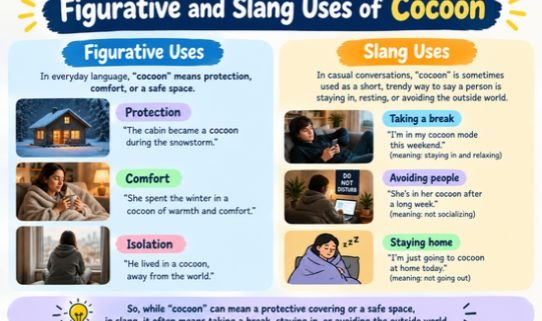
- Comfort: “She wrapped herself in a cocoon of blankets.”
- Protection: “The children grew up in a cocoon of family support.”
- Isolation: “He lived in a cocoon and missed what was happening around him.”
That last example shows that the word can also be negative. When someone is too sheltered, a cocoon can mean they are cut off from reality.
You may also hear the word in everyday slang and lifestyle talk. Cocooning describes staying home and making your space cozy, often with soft lighting, food, and a good show. It is not formal slang with a fixed definition, but people understand it immediately. In daily conversation, “I’m cocooning this weekend” simply means “I’m staying in and relaxing.”
Cocoon as a Verb: Cocoon, Cocooned, Cocooning
Cocoon works as a noun and a verb. Writers often forget the verb forms, and that is where spelling slips again.
- Cocoon: “The caterpillar will cocoon itself in silk.”
- Cocoons: “The moth cocoons itself before winter.”
- Cocooned: “We stayed cocooned in the cabin during the storm.”
- Cocooning: “She is cocooning at home after a busy week.”
Notice that the base spelling never changes. You only add the ending. If you spell the base word right, every form follows.
Cocoon in a Sentence: Real Examples
Examples help the word stick. Here are samples from different settings.
Science and nature
- “The silkworm spun a cocoon in about three days.” (Time varies by species, so treat this as an illustration rather than a rule.)
- “Scientists collected cocoons from the tree bark.”
- “Inside the cocoon, the larva slowly changed.”
Everyday life
- “I curled up in a cocoon of pillows and watched the rain.”
- “The new parents built a cocoon around their baby.”
Work and writing
- “Remote work can create a cocoon that limits teamwork.”
- “The brand sells weighted blankets that feel like a cocoon.”
Fiction
- “She stepped out of her cocoon and faced the crowd.”
You can also use the word in titles or product names. For example, the 1985 film Cocoon uses the same spelling, so it is a handy memory anchor if you know the movie.
Cocoon vs Cacoon: Side-by-Side Comparison

| Feature | Cocoon | Cacoon |
| Correct spelling | Yes | No |
| Found in dictionaries | Yes | No |
| Part of speech | Noun and verb | None |
| Use in formal writing | Acceptable | Counted as an error |
| Meaning | Protective casing or cozy shelter | No meaning |
The takeaway is simple. There is only one version to use.
Easy Ways to Remember the Spelling
You do not need a long list of rules. These three tricks are enough.
- Count the O’s. Cocoon has three O’s and two C’s. Think “C-O, C-O-O-N.” The word is built from the pattern co-coon.
- Link it to “cool” or “moon.” The ending “oon” matches words like moon, soon, and spoon. If you can spell “moon,” you can finish “cocoon.”
- Picture the double O. The two O’s in the middle look like two little round holes. Imagine them as the cozy gap you curl up in.
If you tend to mistype it on a phone, add the word to your personal dictionary so autocorrect stops guessing.
Common Mistakes to Avoid
- Writing “cacoon.” This is the main one. Always start with “coc.”
- Spelling by sound. The soft first syllable misleads you. Trust the pattern instead of your ear.
- Skipping the second O. “Cocon” and “cocoun” are also wrong. The ending must be “oon.”
- Mixing up cocoon and chrysalis. Use “chrysalis” for butterflies and “cocoon” for moths and silkworms.
- Trusting spell check blindly. Re-read the word once before you publish.
Frequently Asked Questions
What is a cacoon?
A cacoon is not a real word. It is a common misspelling of cocoon. If you see it in writing, it was meant to be cocoon.
What is the correct spelling of cocoon?
The correct spelling is c-o-c-o-o-n. It has two C’s and three O’s, with the double O at the end.
Where is the cocoon?
In nature, a cocoon is usually attached to a plant stem, tree bark, a leaf, or a sheltered surface, depending on the species. Many are hidden to protect the insect inside. In a figurative sense, a “cocoon” can be any cozy or sheltered place, such as a bedroom or a home.
What does cocoon mean in slang?
In casual speech, cocooning means staying home and relaxing in a cozy, comfortable space. A person who says they are cocooning is taking a quiet break from going out.
Conclusion
The answer to cocoon or cacoon is clear: cocoon is the only correct spelling. It names the silk casing some insects spin, and it also describes any warm, protected space. Remember the double O, think of “moon” for the ending, and say the word slowly as “co-coon” when you write it. With those small habits, this spelling mistake will stop showing up in your writing.