
You are writing a quick email: “The file is on its way. In the mean time, please review the draft.” Then you stop. One word or two? Writers trip over meantime or mean time all the time, and spell check rarely helps because both forms exist.
A wrong pick can make a polished message look rushed. The fix is a single small rule, and this guide shows you how it works with clear, real examples.
What “Meantime” Means
Meantime is the period between two events. It works as a noun and, less often, as an adverb.
- As a noun: “The bus is late. In the meantime, let’s grab coffee.”
- As an adverb: “The dough needs an hour to rise. Meantime, I will chop the vegetables.”
You will see the noun form far more often, almost always inside the phrase “in the meantime.” It means “while we wait” or “until something else happens.”
Dictionaries list “meantime” as one word. That makes it the standard spelling for this idea.
What “Mean Time” Means
Mean time is two separate words. Here, “mean” is an adjective that means “average” or “middle,” and “time” is a plain noun. Together they describe an average amount of time or a standard way of measuring it.
You find this pair mostly in technical and scientific settings:
- Greenwich Mean Time (GMT): a time standard based on average solar time at Greenwich, England.
- Mean time between failures (MTBF): the average time a system runs before it breaks down.
- Mean time to repair (MTTR): the average time it takes to fix something.
In these phrases, “mean” and “time” do separate jobs, so they stay separate words.
Meantime vs Mean Time: Side-by-Side Comparison
| Feature | Meantime | Mean Time |
| Number of words | One | Two |
| Core meaning | The time between events | Average time |
| Part of speech | Noun or adverb | Adjective + noun |
| Common phrase | In the meantime | Greenwich Mean Time |
| Typical setting | Emails, conversation, everyday writing | Science, engineering, IT, timekeeping |
| Frequency in daily writing | Very common | Rare |
| Standard spelling for “meanwhile” | Yes | No |
The easiest way to read this table: meantime is about waiting, and mean time is about averages.
Is “In the Mean Time” Wrong?
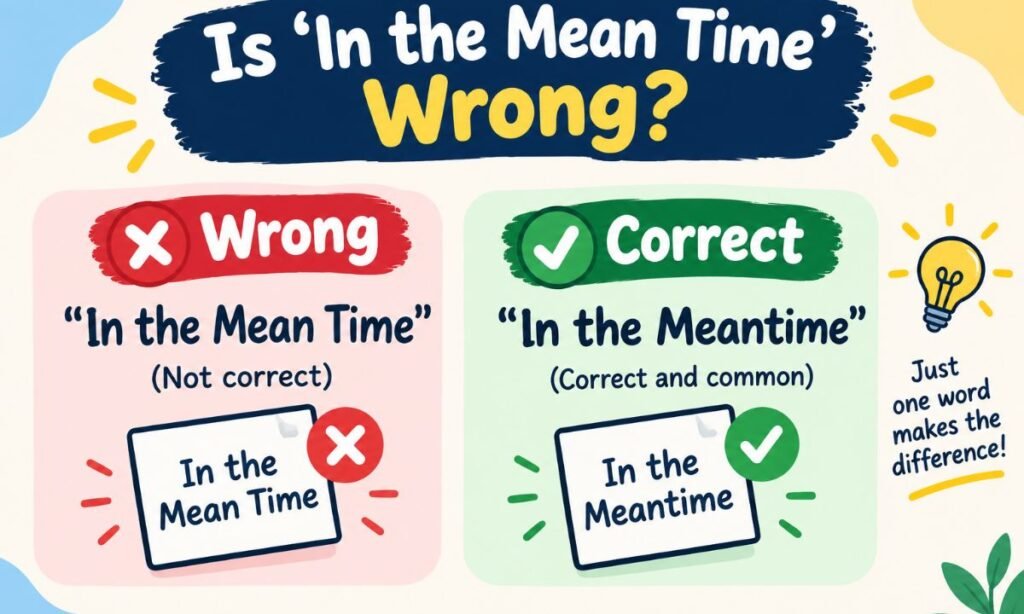
You will see “in the mean time” written as three words, and it is not hard to see why. The words “mean” and “time” are both real English words, so splitting them feels natural.
Still, most dictionaries and style guides treat “in the meantime” as the standard form. Splitting it is a common variant, and many editors will correct it. In formal writing, such as reports, cover letters, or published articles, stick with one word.
Here is a useful way to think about it. If you could swap the phrase with “meanwhile” or “until then,” you want meantime. If you are talking about an average duration, you want mean time.
How to Use “Meantime” in a Sentence
A few small habits make “meantime” sound natural.
Add a comma after it when it starts a sentence.
- “In the meantime, please save your work.”
- “Meantime, the team kept testing.”
Skip the comma when it sits at the end.
- “The kids played outside in the meantime.”
Use “the” before it in the common phrase. Writing “in meantime” without “the” sounds off to most native speakers.
Keep it in the right register. “In the meantime” works in casual and professional writing alike. The bare adverb “meantime” (without “in the”) sounds a bit more formal, and many people prefer “meanwhile” in that spot.
Meantime, Meanwhile, and “For the Meantime”
These phrases overlap, which adds to the confusion.
Meanwhile is the more common adverb. It means “at the same time” or “during the interval.” You can often replace the adverb “meantime” with “meanwhile,” but “meanwhile” does not work after “in the.” You cannot say “in the meanwhile” in standard English.
“For the meantime” is a different story. People use it to mean “for now,” as in “For the meantime, we will use the old system.” Some writers consider it a blend of “in the meantime” and “for the time being.” It is understood, but many style-minded editors prefer one of those two phrases instead.
A quick guide:
- Waiting for something to happen? Use “in the meantime.”
- Describing a temporary arrangement? Use “for the time being.”
- Starting a new sentence about something happening alongside? Use “meanwhile.”
Where “Mean Time” Shows Up in Real Life
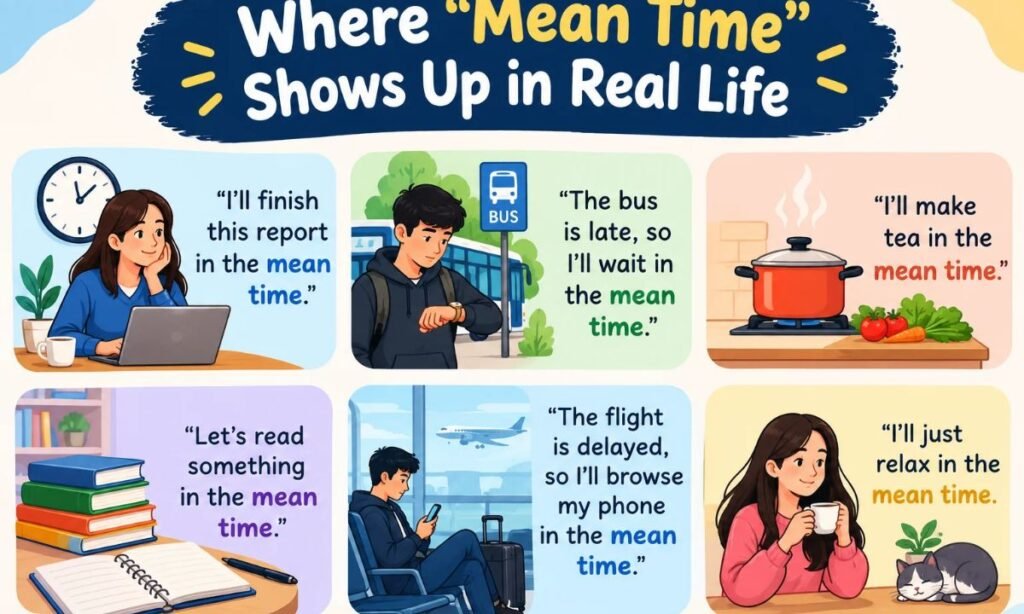
Because “mean time” is technical, you may never need it unless your work involves time standards or reliability. But it is worth recognizing.
- Timekeeping: Greenwich Mean Time is the classic example. It is tied to average solar time and is the reason you see “GMT” in time zone conversions.
- IT and operations: Teams track mean time to repair and mean time between failures to measure how reliable a system is.
- Manufacturing and engineering: The same average-time idea helps teams plan maintenance.
In all of these, “mean” means “average.” You are not talking about waiting, so the two-word form is correct.
Example Sentences for Everyday Situations
In emails
- We are still waiting on approval. In the meantime, I will prepare the slides.
- The invoice will arrive Friday. In the meantime, please keep the receipt.
In daily life
- Dinner won’t be ready for an hour. In the meantime, there are snacks.
- My flight leaves at six. In the meantime, I am finishing my packing.
In messages and social posts
- New episode drops Friday. In the meantime, binge the last season.
- Closing early today. Meantime, check our website for updates.
With “mean time” (technical use)
- The server’s mean time between failures is about six months.
- The meeting is at 3 p.m. Greenwich Mean Time.
- Our mean time to repair dropped after we trained the team.
Notice the difference in tone. The first three groups are about waiting. The last group is about averages and standards.
Common Mistakes to Avoid
1. Splitting “meantime” in everyday phrases
“In the mean time” is the most common slip. If you mean “meanwhile,” write one word.
2. Using “meantime” for technical averages
Writing “Greenwich Meantime” or “meantime between failures” is incorrect. Those phrases need the two-word form because “mean” means “average.”
3. Dropping “the” from the phrase
“In meantime” sounds incomplete. Keep it as “in the meantime.”
4. Forgetting the comma
When “in the meantime” opens a sentence, add a comma right after it.
5. Mixing up “for the meantime” and “in the meantime”
They are not interchangeable in careful writing. “In the meantime” covers a wait, and “for the time being” covers a temporary arrangement.
An Easy Way to Remember the Difference
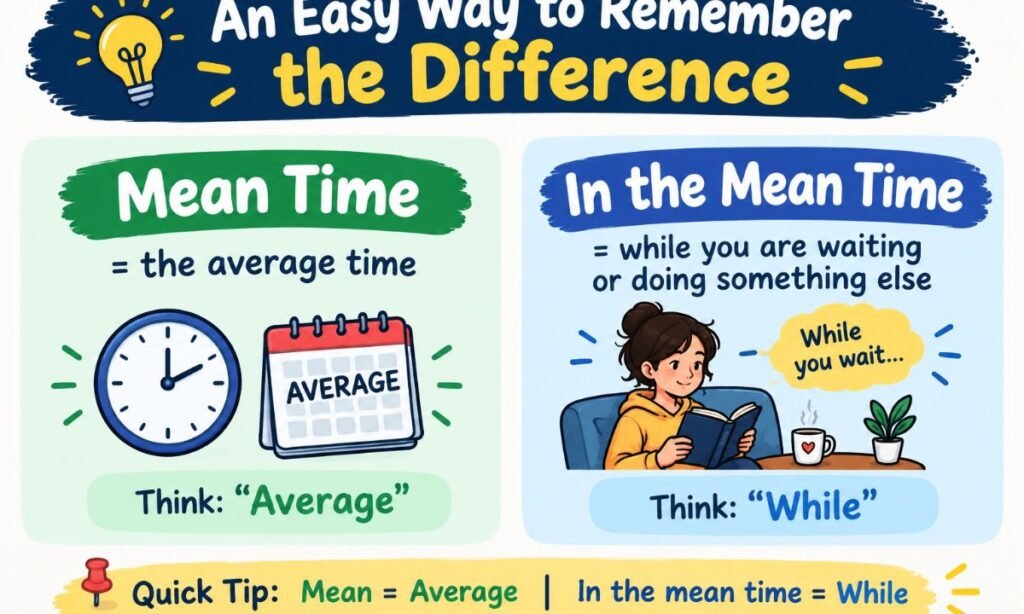
Ask one question: Am I talking about waiting, or about averages?
- Waiting? Write one word: meantime.
- Averages? Write two words: mean time.
If you want a second trick, try swapping in “meanwhile.” If the sentence still makes sense, you want meantime. If it would sound strange, you are likely looking at a technical use and need mean time.
Frequently Asked Questions
Is it “in the mean time” or “in the meantime”?
The standard form is “in the meantime” (one word). The three-word version appears in casual writing, but dictionaries and most style guides prefer the single word. Use it in emails, reports, and anything formal.
Is “for the meantime” grammatically correct?
It is widely understood, but many editors consider it a mix of “in the meantime” and “for the time being.” If you want to stay safe, use “in the meantime” for waiting periods and “for the time being” for temporary arrangements.
What is the meaning of “mean time”?
Mean time is a two-word phrase where “mean” means “average.” It appears in terms like Greenwich Mean Time, mean time between failures, and mean time to repair. It is a technical term, not a casual expression for waiting.
Is “meantime” all one word?
Yes. When you mean “the time between events” or “meanwhile,” meantime is written as one word. You only use two words when “mean” means “average.”
Conclusion
The meantime or mean time question comes down to meaning. Use meantime (one word) when you are talking about the stretch between two events, especially in the phrase “in the meantime.” Use mean time (two words) only when “mean” means “average,” as in Greenwich Mean Time or reliability terms like mean time between failures.
For most everyday writing, one word is the answer. Keep that rule in your back pocket, and the next time an email needs a quick bridge between “now” and “later,” you will write it with confidence.

Alexander John grammar content writer with 4 years of experience creating accurate, engaging, and SEO-friendly content. I specialize in spelling differences, commonly confused words, vocabulary, grammar rules, and writing tips. My goal is to simplify English for learners through clear explanations, practical examples, and helpful articles.