
You write a joke in your essay, then spot a red squiggle under your word. Is it humour or humor? One looks fancy, the other looks plain, and neither feels wrong. If you pick the wrong one for your audience, a teacher, editor, or client may mark it as a mistake. The fix is simple.
Humour or Humor is not about right versus wrong. It is about where your reader lives, and once you know that rule, you can choose in seconds.
What Humor and Humour Mean
Humor (or humour) is the quality that makes something funny, and the ability to notice, enjoy, or create funny things. It can also describe a person’s mood, though that use is now old fashioned.
Here are the main meanings you will meet:
- Funniness: “The movie has plenty of humor.”
- A sense of fun: “She has a great sense of humor.”
- A style of comedy: “He loves dry humor and sarcasm.”
- A mood (dated): “He was in a good humour this morning.”
Notice that every meaning works with either spelling. The spelling never changes the definition.
Humor vs Humour at a Glance
| Feature | Humor | Humour |
| Variety of English | American | British |
| Also used in | United States | UK, Canada, Australia, New Zealand, Ireland, India, South Africa |
| Meaning | Funniness, a sense of fun | Funniness, a sense of fun |
| Adjective | humorous | humorous |
| Person who writes it | humorist | humorist |
| Without humor | humorless | humourless |
| Pronunciation | HYOO-mer | HYOO-muh (UK) |
| Example | “Her humor is dry.” | “Her humour is dry.” |
The only real difference is the letter u. Everything else stays the same.
Why Two Spellings Exist
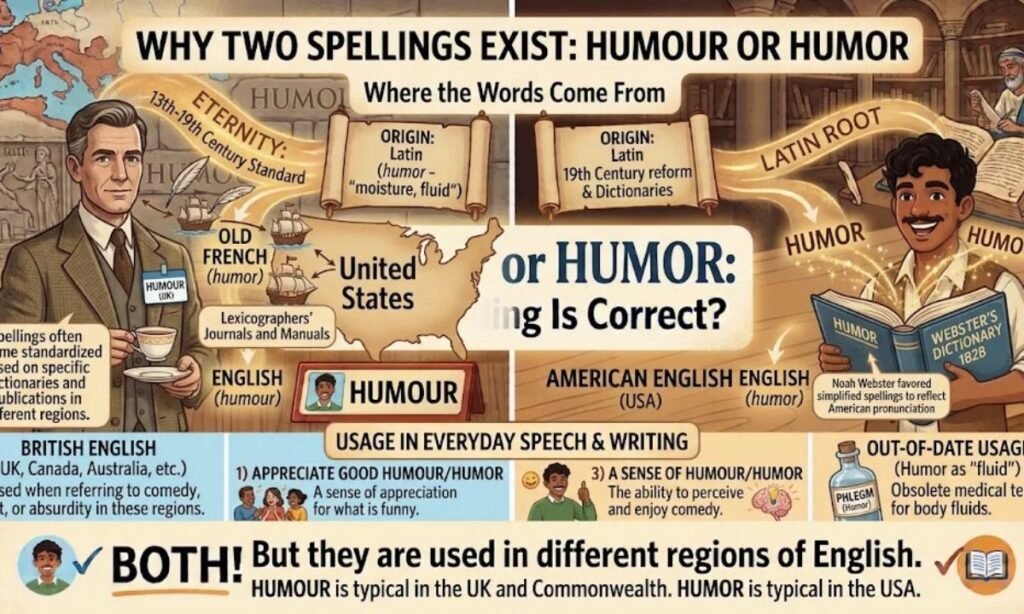
The word came into English from Old French, where it was spelled with -our or -or. English writers used both forms for centuries, and the spelling was not fixed.
In the early 1800s, American lexicographer Noah Webster pushed for simpler spellings. His 1828 dictionary favored forms like color, honor, and humor. Many Americans adopted them. Britain kept the older -our forms, which remain standard there today.
So the split is not about one country being sloppy. It is two spelling traditions that grew apart.
Which Spelling to Use by Country
Use the spelling your reader expects.
- United States: humor
- United Kingdom: humour
- Canada: humour (Canadian English keeps the u in words like colour, honour, and humour)
- Australia and New Zealand: humour
- Ireland, India, South Africa: humour
If you are writing for a global audience, pick one spelling and stay with it. You can also follow the style guide of the publication, school, or company you are writing for.
A quick tip for writers: your spell checker’s language setting controls this. If your document is set to English (US), it will flag humour. Switch it to English (UK) or English (Canada), and it will flag humor instead.
Related Words and How They Are Spelled
Here is where many people slip. The u disappears in some related words, even in British English.
| Word | US spelling | UK spelling |
| Funny quality | humor | humour |
| Funny (adjective) | humorous | humorous |
| Comedy writer | humorist | humorist |
| No sense of fun | humorless | humourless |
| Laughing at oneself | self-deprecating humor | self-deprecating humour |
The key point: humorous and humorist drop the u in both countries. Writing “humourous” is a spelling mistake in every variety of English. The British keep the u only in the base noun and in words like humourless.
How to Say It
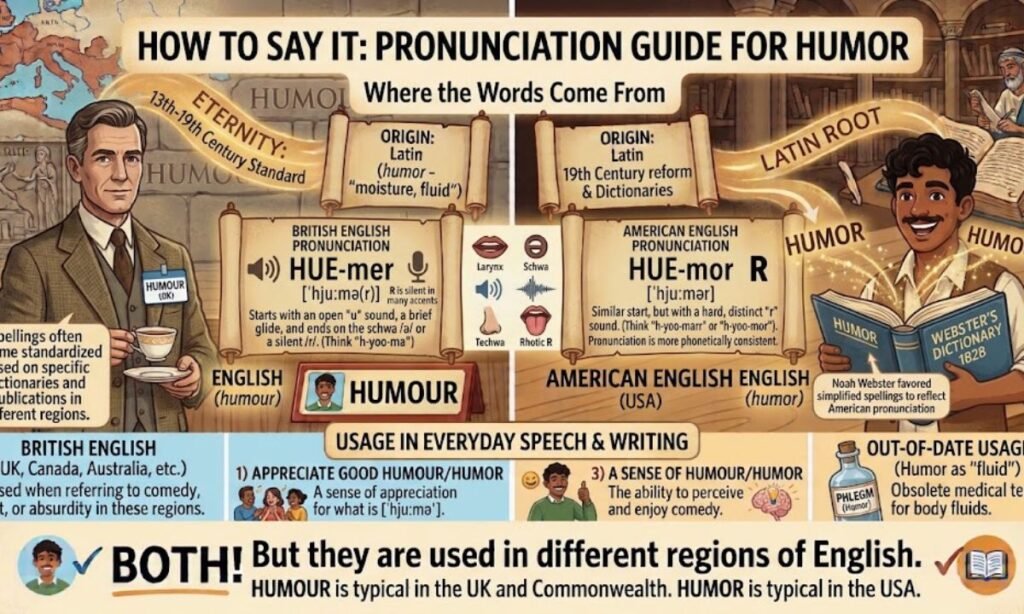
The two spellings sound almost the same. Both start with a “hyoo” sound, and the difference is in the ending. Many American speakers pronounce the final r (HYOO-mer), while many British speakers drop it (HYOO-muh). That is an accent difference, not a spelling difference.
Some speakers in both countries say the first sound as “yoo,” so you may hear YOO-mer. That is normal too.
Example Sentences
Seeing the words in real sentences makes the choice easier.
American English (humor):
- Her humor kept the whole team laughing during the long meeting.
- A good sense of humor helps in almost every job.
- The show mixes dark humor with real heart.
- He used humor to calm a nervous crowd.
British English (humour):
- Her humour kept the whole team laughing during the long meeting.
- British humour often relies on irony and understatement.
- The sitcom is famous for its dry humour.
- He lost his humour after the third delay.
Both varieties (same spelling):
- It was a humorous story about a lost dog.
- She is a well known humorist and columnist.
Common Mistakes to Avoid
1. Mixing both spellings in one document. Wrong: “Her humor was sharp, and his humour was softer.” Right: Choose one spelling and use it everywhere.
2. Writing “humourous.” Wrong: “It was a humourous moment.” Right: “It was a humorous moment.”
3. Using the wrong spelling for the audience. If you are writing for an American teacher or publisher, use humor. If the audience is British or Canadian, use humour.
4. Thinking the spelling changes the meaning. It does not. A sense of humor and a sense of humour are the same thing.
5. Trusting autocorrect blindly. Check your language setting before you send. A wrong setting can quietly change every spelling in your document.
Other Words That Follow the Same Pattern
Humor is one of many word pairs where American English drops the u. If you learn the pattern once, you can apply it to a whole group.
| American | British |
| color | colour |
| favor | favour |
| honor | honour |
| neighbor | neighbour |
| labor | labour |
| flavor | flavour |
| harbor | harbour |
| rumor | rumour |
Memory trick: US spelling is shorter. Americans often leave out the extra u, while the British keep it. If you remember that one rule, you will rarely mix them up.
There are a few exceptions. Americans still write glamour, and British English spells some related words without the u, such as honorary and honorific. When unsure, check a dictionary.
Where the Word “Humor” Came From
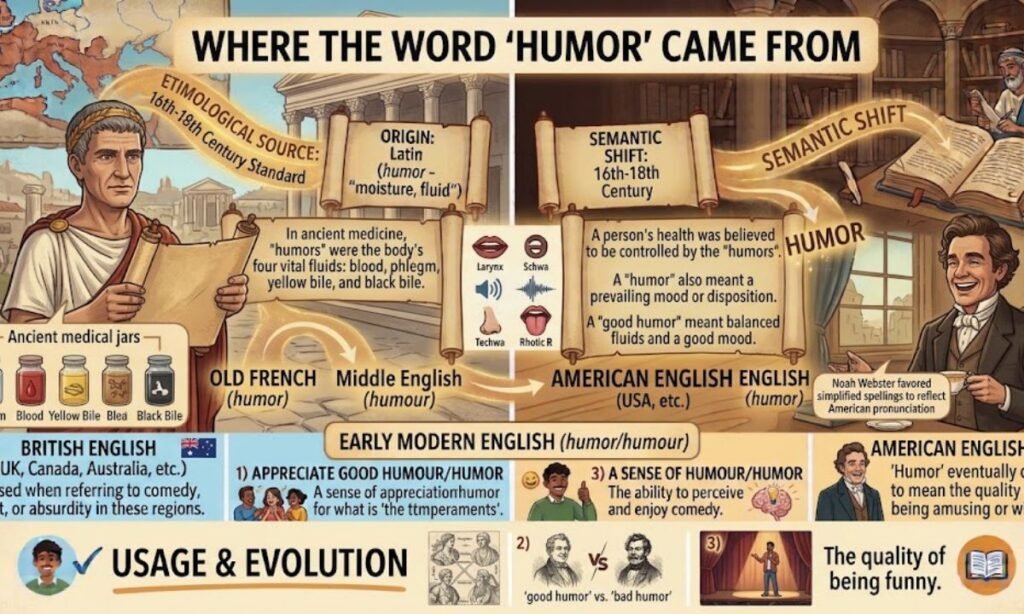
The word has an unusual history. It comes from the Latin word for “fluid.” In old medicine, people believed the body held four main fluids, called the four humors: blood, phlegm, yellow bile, and black bile. Doctors thought your mood and health depended on the balance between them.
Over time, “humor” came to describe a person’s mood or temperament. Someone could be “in a good humor” or “in a bad humor.” Later, the meaning narrowed to what we use today: the quality of being funny.
This also explains the old phrase bad humors, which referred to an imbalance of bodily fluids, not a lack of jokes.
Frequently Asked Questions
How do you spell good humor?
Spell it humor in American English and humour in British English. “Good humor” or “good humour” both mean a cheerful mood or an enjoyable sense of fun. Pick the spelling that matches your audience and keep it consistent.
Are humor and humour the same?
Yes. They are two spellings of the same word with the same meaning and pronunciation. Humor is American English, and humour is British English. Only the letter u is different.
What are examples of humour?
Common types include dry humour (deadpan jokes), slapstick (physical comedy), sarcasm, puns, satire, and self-deprecating humour. A sample sentence: “His dry humour made the long meeting bearable.”
What were bad humors?
In old medicine, “bad humors” meant an imbalance in the four body fluids: blood, phlegm, yellow bile, and black bile. People believed this imbalance caused illness and bad moods. The idea is outdated, but the word survives in older writing.
Conclusion
The choice between Humour or Humor comes down to your audience. Write humor for American readers and humour for British, Canadian, Australian, and most other readers. The meaning never changes, and humorous is spelled the same everywhere.
Pick one spelling, check your spell checker’s language setting, and stay consistent from the first line to the last. That small habit keeps your writing clean, and your jokes can do the real work.