
You are texting a friend about a coworker who stayed totally calm during a meltdown, and your thumbs stop. Is it unphased or unfazed? Both look right, and autocorrect keeps quiet. Send the wrong one and your sharp sentence ends with a tiny, embarrassing wobble.
The fix is simple. Once you know where the word comes from, you will pick the right spelling every time, and you will know the one rare case where the other spelling works.
What Does “Unfazed” Mean?
Unfazed is an adjective. It describes a person who stays composed when something surprising, stressful, or intimidating happens.
- “The goalie was unfazed by the loud crowd.”
- “She stayed unfazed when the projector died mid-talk.”
- “Our dog is unfazed by thunder, which is more than I can say for me.”
The word is built from three parts: the prefix un- (not), the verb faze (to disturb or rattle), and the ending -ed. So “unfazed” literally means “not rattled.”
Because it is an adjective, it usually pairs with the word by. You are unfazed by criticism, unfazed by a deadline, or unfazed by a spider the size of a quarter.
One small detail: being unfazed does not mean you felt nothing. It means the event did not knock you off balance. A nervous speaker who takes a breath and keeps going is unfazed, even if their heart is racing. That is why the word shows up so often in stories about calm under pressure.
Where “Faze” Comes From and Why It Is Not “Phase”
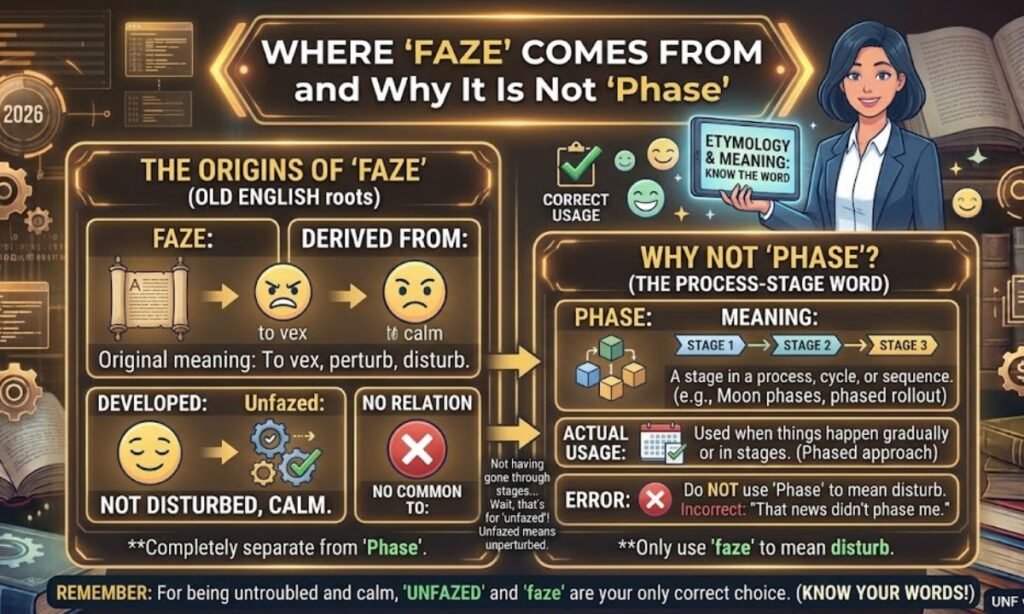
Faze is an older English verb that means to disturb someone’s calm or throw them off. It traces back to older English words about driving something away or frightening it, and it settled into its modern meaning in American English in the 1800s.
Phase is a different word with a different job. It is mostly a noun meaning a stage in a process, such as the phases of the moon or the first phase of a project. It also works as a verb in phrases like “phase out” and “phase in.”
The two words sound identical, which is the whole problem. Your ear cannot tell them apart, so your spelling has to.
| Word | Part of speech | Core meaning | Example |
| faze | verb | to rattle or disturb | “Nothing seems to faze her.” |
| phase | noun, verb | a stage, or to do in stages | “We will phase in the new system.” |
Is “Unphased” a Real Word?
Mostly, no. When someone writes “unphased” to mean calm or unbothered, standard dictionaries and style guides treat it as an error. The expected form is unfazed.
There is one narrow exception. Because phase is a real word, “unphased” can be built from it to mean “not done in phases.” You might read about an unphased rollout, meaning a plan that launches all at once instead of in stages. That use is rare, technical, and has nothing to do with staying calm.
So here is the quick test:
- Talking about someone’s reaction or mood? Use unfazed.
- Talking about stages or phases of a plan? “Unphased” is possible, but “not phased” or “all at once” reads more clearly.
Unphased vs Unfazed at a Glance
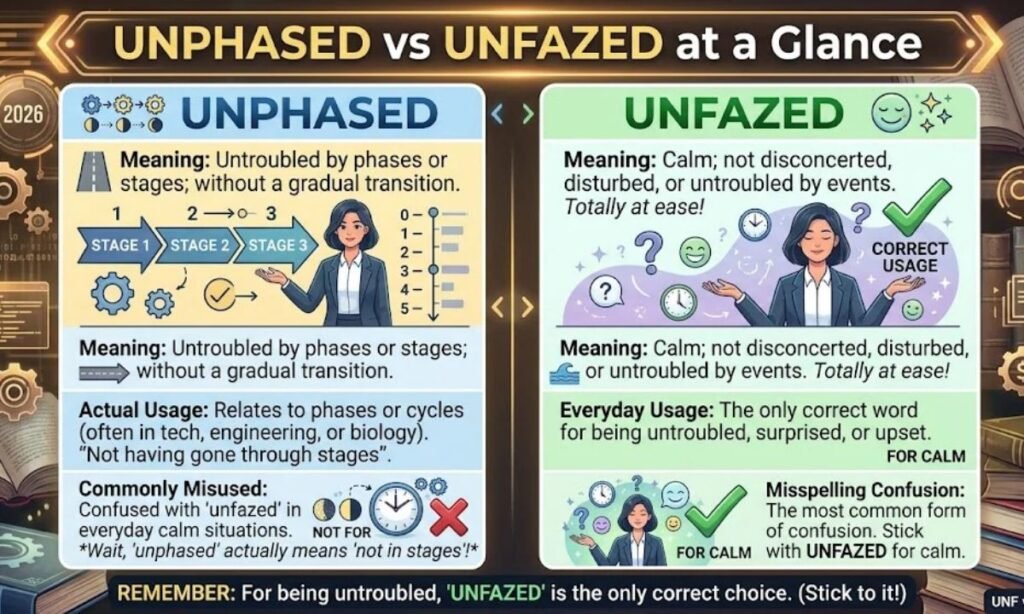
| Unfazed | Unphased | |
| Standard spelling for “calm” | Yes | No |
| Root word | faze (to rattle) | phase (a stage) |
| Typical meaning | Not bothered or disturbed | Not done in stages (rare) |
| Safe in formal writing | Yes | Only in technical contexts |
| Common error | Rarely misspelled on purpose | Often typed by mistake for “unfazed” |
Why So Many People Write “Unphased”
The mistake is easy to understand. Three things push people toward it.
The words sound the same. Faze and phase are homophones, and we usually learn “unfazed” by ear in conversation, not from reading.
Phase is the more familiar word. Most people have seen “phase” far more often than “faze,” so the brain reaches for the spelling it knows best.
It looks logical. “Phase” feels like it could mean “disturb,” as in “that doesn’t phase me.” The sentence reads smoothly, so the typo does not jump out.
Faze is almost always used with a negative. We say “it didn’t faze her” or “nothing fazes him” far more than “it fazed her.” That means many people only meet the word in one shape and never get a feel for its spelling.
Seeing the wrong spelling online does not help, either. Once a typo shows up in captions, comments, and posts, it starts to look normal. Popular does not mean correct, though.
How to Use “Unfazed” in a Sentence
Here are examples across different tones, so you can see how flexible the word is.
Work and school
- “The new manager was unfazed by the tight deadline.”
- “Students were unfazed by the pop quiz because they had studied all week.”
Sports and performance
- “The rookie looked unfazed in her first championship game.”
- “The band stayed unfazed when a string snapped on stage.”
Daily life
- “He was unfazed by the long line at the airport.”
- “My toddler is unfazed by bedtime rules, which is a problem.”
Describing a group or a thing
- “An unfazed crowd kept cheering through the rain.”
- “The company seemed unfazed by the bad press.”
You can also use the verb forms: faze, fazes, fazed, fazing. For example, “Criticism never fazes her,” or “I wasn’t fazed at all.”
Unfazed in Everyday Writing
Where you write changes the tone, not the spelling. Unfazed is correct everywhere.
In emails. It sounds calm and professional. “The team remained unfazed by the schedule change, and we are on track for Friday.”
In text messages. It often means “I’m not bothered,” sometimes with a bit of attitude. “He cancelled again and I’m honestly unfazed.” Here it works much like the casual word “unbothered.”
On social media. Captions love it. “Monday came, and I stayed unfazed.” Keep the spelling right and your post looks sharper.
In essays and reports. It fits neatly in neutral, formal writing. “The committee appeared unfazed by the opposition.” No need to swap it for something fancier.
Words That Mean the Same as “Unfazed”
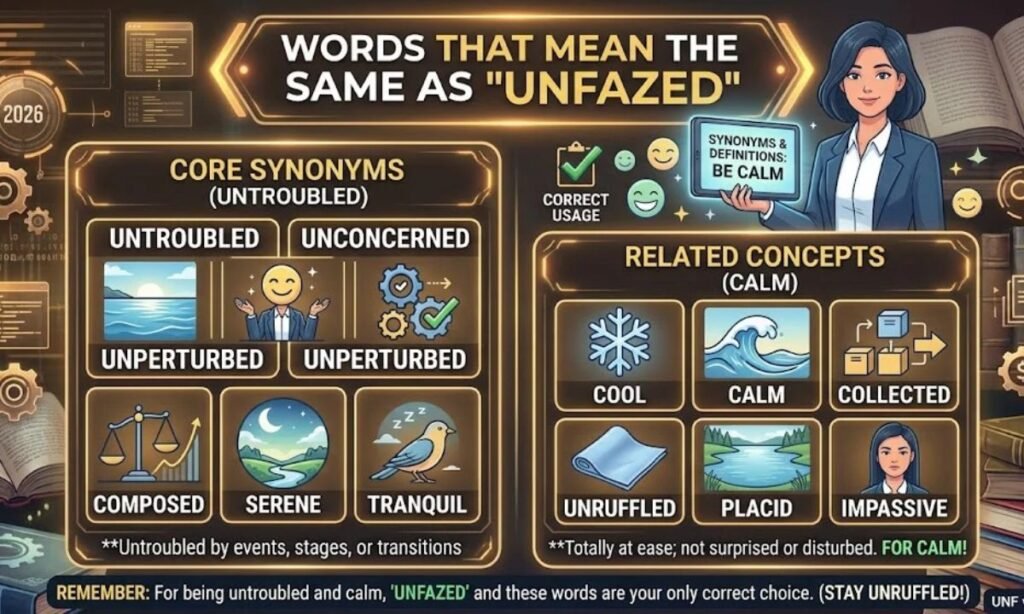
If you want variety, or you are not sure you can spell it under pressure, these words carry a similar meaning:
- Unbothered: casual, great for texts and captions
- Unruffled: calm on the surface, a bit polished
- Composed: formal and steady
- Unflappable: describes someone who stays calm by nature
- Unperturbed: formal, common in writing
- Undaunted: calm in the face of a challenge
- Nonchalant: relaxed, sometimes almost too relaxed
Small differences matter. Undaunted suggests courage against something big, while nonchalant can suggest you do not care much. Unfazed sits in the middle: you saw it, and it did not shake you.
Common Mistakes With Unfazed and Unphased
Mistake 1: Writing “unphased” for “calm.” This is the main slip. Fix it by swapping in “unfazed.”
Mistake 2: Spelling the verb as “phase” too. “It doesn’t phase me” should be “It doesn’t faze me.”
Mistake 3: Mixing the sentence structure. “Unfazed” describes a person or thing. “Faze” is the action. Compare “She was unfazed” with “The noise did not faze her.”
Mistake 4: Trusting the first search result or a viral caption. If a post uses “unphased,” do not copy it. Check a dictionary.
Mistake 5: Overcorrecting. Do not change “phased rollout” or “phase out” to “fazed.” Those are correct as written, because they are about stages.
Easy Ways to Remember the Spelling
Try one of these memory tricks:
- Faze rhymes with daze. Both words are about being rattled. If you can say “dazed,” you can say “fazed.”
- Z is for zapped. Something that fazes you zaps your calm. The letter Z sits right in the word.
- Phase has the “ph” of “stage.” Think “phase = phases of a plan.” If it is not about stages, do not use ph.
- The swap test. Replace the word with “bothered.” If “unbothered” fits, you need unfazed.
A short practice round helps too. Fill in each blank with faze or phase:
- “The heat did not ____ the runners.” (faze)
- “We will start the next ____ on Monday.” (phase)
- “She stayed ____ by the news.” (unfazed)
Frequently Asked Questions
Why is it unfazed and not unphased?
Because the word comes from the verb faze, meaning to disturb or rattle. “Phase” is a separate word about stages, so it does not belong in this adjective.
What does being unfazed mean?
It means staying calm and not being bothered by something surprising, stressful, or scary. For example, “She was unfazed by the criticism.”
Is “unphased” ever correct?
Rarely. It can mean “not done in phases,” such as a project with no staged rollout, but it is not the right spelling for staying calm.
What is another word for unfazed or unphased?
Good options are unbothered, unruffled, composed, unflappable, and unperturbed. Pick the one that fits your tone, casual or formal.
Can I use unfazed in formal writing?
Yes. Unfazed is a standard English word and works well in emails, essays, and reports.
Conclusion
When you mean calm, steady, or unbothered, the word is unfazed. It comes from faze, a verb about being rattled, and not from phase, a word about stages. “Unphased” is the common misspelling, with only a rare technical use for plans that are not done in stages.
Keep the swap test handy: if “unbothered” fits the sentence, write unfazed. A little attention to this one word will keep your emails, captions, and essays looking polished.