
Picture this: you are replying to a coworker and want to say “please bear with me.” You type it, pause, and wonder if it should be “bare with me.” Your cursor hovers.
This bear or bare mix-up catches smart people every day, because the two words sound identical and look almost the same. Pick the wrong one and your message can end up asking someone to undress with you. Here is a clear, simple way to choose correctly every time.
What Does “Bear” Mean?
Bear is both a verb and a noun, which is why it has so many uses.
As a verb, bear can mean:
- To carry or support: The old bridge cannot bear heavy trucks.
- To endure or put up with: I cannot bear the noise.
- To give birth or produce: The tree bears fruit every summer.
- To take responsibility for: The company will bear the cost of repairs.
- To hold in mind or show: The letter bears her signature.
As a noun, bear means:
- The animal: A brown bear crossed the trail.
- A person who is rough or grumpy (informal): He is a bear before his morning coffee.
- A pessimistic investor in a market (finance term): Bears expect prices to fall.
What Does “Bare” Mean?
Bare is mostly an adjective, but it can also be a verb.
As an adjective, bare can mean:
- Uncovered: She walked on the beach with bare feet.
- Empty or without extras: The room had bare walls.
- Basic or minimal: He packed only the bare essentials.
- Without anything added: The report gives the bare facts.
As a verb, bare means to uncover or expose:
- The dog bared its teeth.
- He bared his soul in the letter.
In short, bare is about what is stripped down or uncovered, while bear is about carrying, enduring, or the animal.
Bear vs Bare at a Glance
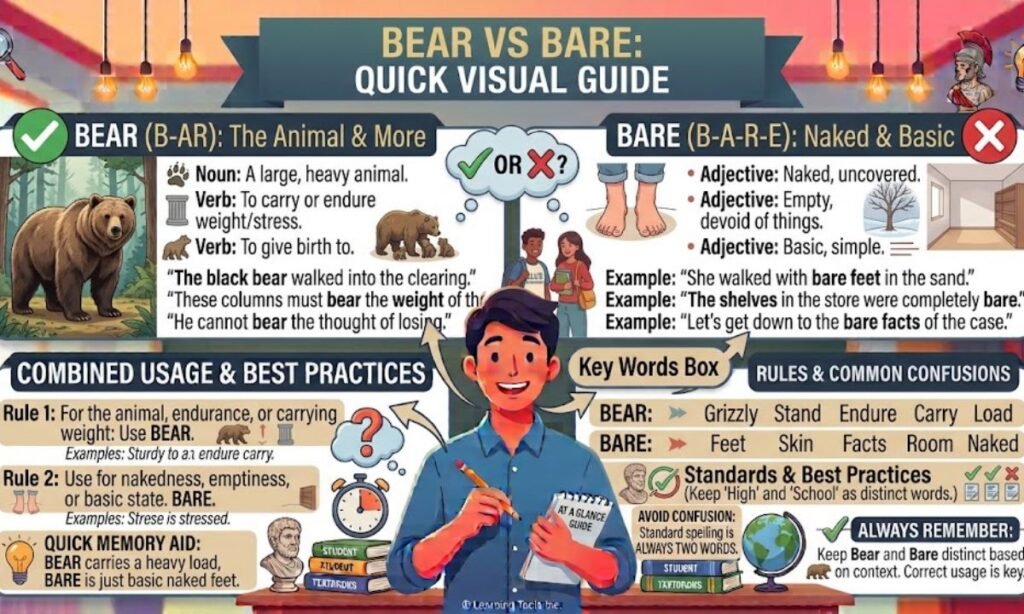
| Feature | Bear | Bare |
| Part of speech | Verb, noun | Adjective, verb |
| Core idea | Carry, endure, produce, or the animal | Uncovered, empty, basic |
| Past tense | Bore | Bared |
| Past participle | Borne or born | Bared |
| Common phrases | bear with me, bear in mind | bare minimum, bare feet |
| Example | I cannot bear the heat. | The tree has bare branches. |
| Sounds like | “bair” | “bair” |
The sound is identical, so the meaning is your only guide.
Why Do Bear and Bare Sound the Same?
Bear and bare are homophones, which means they have the same pronunciation but different meanings and spellings. English has many pairs like this, including their and there, peace and piece, and pair and pear.
The reason is partly history. English spelling froze at one point while pronunciation kept changing, and words that once sounded different slowly came together. Since the sounds merged, your ear cannot help you here. You have to check the meaning.
Easy Ways to Remember Which One to Use
Try one of these simple tricks.
The animal trick. The animal is a bear, and the word ends in ear. Bears have ears. If your meaning involves carrying or enduring, think of a bear carrying a heavy load.
The “a” trick for bare. Bare has an a and an e, like the word bare in “bare skin.” Picture something stripped down to its basics.
The swap test. Replace the word with a synonym.
- Swap in “carry” or “tolerate”? Use bear.
- Swap in “uncovered” or “empty”? Use bare.
The “with me” test. You ask someone to be patient, which means they put up with you. That calls for bear, so it is “bear with me.”
Bear With Me or Bare With Me?

The correct phrase is “bear with me.” It is a polite way to ask for patience, as in “Please bear with me while I find the file.”
“Bare with me” is a common mistake. It would literally suggest you want someone to be uncovered with you, which is not what you mean.
The same pattern shows up in related phrases:
- Bear in mind: keep something in your thoughts. “Bear in mind that the store closes early.”
- Bear the pain: endure it. “She learned to bear the pain.”
- Bear witness: give evidence or observe. “The photos bear witness to the storm.”
All of these use bear, because the meaning is about holding, carrying, or enduring.
Common Phrases With Bear and Bare
Knowing set phrases helps you pick the right word without thinking.
Phrases with bear:
- Bear fruit: produce a good result. “Their hard work finally bore fruit.”
- Bear a grudge: hold resentment.
- Bear responsibility: take the blame or duty.
- Bear down: apply pressure or focus hard.
- Grin and bear it: put up with something unpleasant.
- Bear the brunt: take the worst of it.
- Bear market: a time when stock prices fall.
Phrases with bare:
- Bare minimum: the smallest amount needed.
- Bare bones: only the basics.
- Bare necessities: only what you absolutely need.
- Lay bare: reveal or expose. “The report laid bare the problems.”
- Bare hands: without gloves or tools.
- Bare your soul: share your deepest feelings.
The Tricky Past Tense: Bore, Borne, and Born
Bear is an irregular verb, so its past forms deserve their own look.
- Bore is the simple past: “She bore the weight easily.”
- Borne is the past participle for carrying, enduring, or producing: “The cost was borne by the company.”
- Born is used for birth, mainly in the passive: “He was born in 2001.”
A good guide: use born when talking about being delivered at birth, and borne for most other uses. There is one exception. When a mother is the subject, writers use “borne,” as in “She has borne three children.”
Bare is much simpler. Its past tense and participle are both bared: “The dog bared its teeth.”
Bear or Bare in Real Sentences
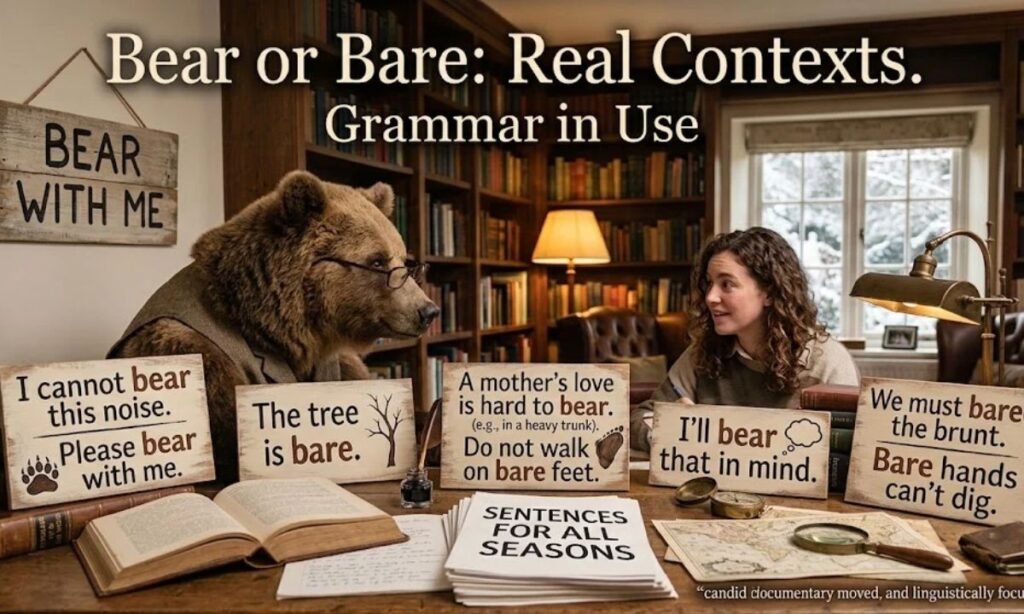
Examples make the difference easier to see.
In emails:
- Please bear with me while I update the spreadsheet.
- We have only the bare minimum of data so far.
In news writing:
- The city will bear the cost of the new bridge.
- Protesters stood in the square with bare hands raised.
On social media:
- I cannot bear how cute this puppy is.
- Spotted a bear near our campsite this morning.
In daily conversation:
- Bear in mind that the bus runs less often on Sundays.
- The kitchen felt cold with its bare white walls.
In school writing:
- The author lays bare the character’s fears in chapter three.
Is It “Bare Feet” or “Barefoot”?
Both are correct, but they work a little differently.
- Bare feet uses bare as an adjective: “Her bare feet felt the warm sand.”
- Barefoot is one word and works as an adjective or an adverb: “She walked barefoot.” “A barefoot child ran by.”
Do not write “bear feet.” Unless you mean the feet of an actual bear, it is always bare.
Common Mistakes With Bear and Bare
- Writing “bare with me.” The right phrase is “bear with me.”
- Writing “bare in mind.” Use “bear in mind.”
- Writing “bear minimum.” The correct phrase is “bare minimum.”
- Using “bear” for uncovered things. Use “bare” for bare skin, bare walls, and bare feet.
- Mixing up “born” and “borne.” Use “born” for birth and “borne” for most other uses.
- Trusting spell check. Both words are real, so a spelling tool rarely flags them. Read the meaning, not just the letters.
Quick Practice: Test Yourself

Choose bear or bare for each blank. The answers are below.
- Please ______ with me for a moment.
- The shelves were ______ after the sale.
- We saw a ______ near the lake.
- I cannot ______ this heat.
- She packed the ______ minimum for the trip.
Answers: 1. bear, 2. bare, 3. bear, 4. bear, 5. bare.
Frequently Asked Questions
Is it bare or bear the pain?
It is bear the pain. In this phrase, “bear” means to endure. “Bare” would not make sense here.
Do I use bear or bare?
Use bear when you mean carry, endure, produce, or the animal. Use bare when you mean uncovered, empty, or the most basic amount.
Is it bare with me or bear with me?
The correct phrase is bear with me. It asks someone to be patient, and “bear” means to put up with.
Is it bear or bare in mind?
It is bear in mind. The phrase means to keep something in your thoughts, and “bear” is the right verb for holding an idea.
Conclusion
The bear or bare choice comes down to meaning. Use bear for carrying, enduring, producing, or the animal. Use bare for something uncovered, empty, or basic. When you are unsure, swap in a synonym like “endure” or “uncovered” and see which one fits.
Pingback: Accommodation vs Accomodation: Which Spelling Is Correct?