
You are writing about a tire pressure reading, a wire size, or how a crowd might react, and then you freeze: gage or gauge? Both spellings look legitimate, and you may have seen each one in print.
Pick the wrong one for your audience and your page can look sloppy or inconsistent. The good news is that the choice is easier than it seems. One spelling works almost everywhere, and the other has a few narrow jobs. Here is how to tell which is which.
What Does Gauge Mean?
Gauge works as both a noun and a verb, and it is the spelling nearly every dictionary lists first.
As a noun, gauge can mean:
- A measuring instrument: a fuel gauge, a pressure gauge, a rain gauge
- A standard measurement: the thickness of sheet metal, the diameter of wire, or the size of a shotgun bore (12 gauge)
- The distance between two rails: standard gauge railway track
- A way to judge something: a gauge of public opinion
As a verb, gauge means to measure or to estimate:
- She tried to gauge the mood in the room.
- We used a probe to gauge the depth of the water.
- The survey will gauge how customers feel about the new design.
Both gauge and gage are pronounced the same way: “gayj.”
What Does Gage Mean?
Gage has a few separate uses, and this is where the confusion starts.
1. A variant spelling of gauge. In the United States, gage appears in some technical, manufacturing, and engineering writing. Examples include strain gage, gage block, and go/no-go gage. Some companies, standards, and trade materials use this spelling as a house style.
2. A pledge or security (old usage). In older English, a gage was something given as a promise or a challenge. You may see it in historical or legal writing, such as the phrase “throw down the gage,” meaning to issue a challenge.
3. A name. Gage is also a surname and a place name, and it is a given name for some people. In those cases, the spelling is simply the name.
For general writing, assume the first meaning is rare and the safest choice is still gauge.
Gage vs Gauge: Side-by-Side Comparison
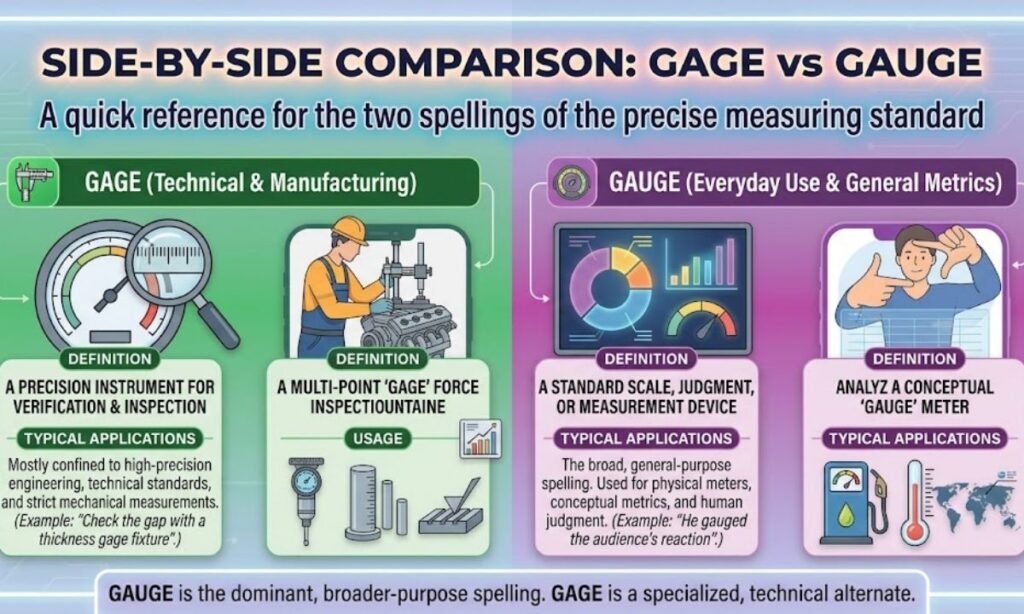
| Feature | Gauge | Gage |
| Status | Standard spelling | Accepted variant |
| Pronunciation | gayj | gayj |
| Everyday writing | Yes | Rarely |
| Verb use (“to estimate”) | Yes | Very uncommon |
| Technical and engineering writing | Common | Seen in some US settings |
| Historical meaning of “pledge” | No | Yes |
| Safe default? | Yes | Only when a field or brand requires it |
Why Do Both Spellings Exist?
English has several spellings that came from the same source in different forms. Both words trace back to Old French, where the word for a measuring standard and the word for a pledge sat close together. Over time, writers settled on gauge for most meanings, while gage survived in specialized areas and in the older “pledge” sense.
American technical writing kept gage in some places because certain industries standardized on the shorter spelling in their documents. That is a style choice within those fields, not a different word with a different meaning.
For you as a writer, the practical lesson is simple. Standard references favor gauge, and gage is the exception you follow only when a specific audience or style guide asks for it.
How to Choose Between Gage and Gauge
Use these quick rules.
Use gauge when you are:
- Writing for a general audience, such as a blog, news article, or school paper
- Using the word as a verb (“gauge interest”)
- Naming everyday objects (fuel gauge, tire gauge, rain gauge)
- Describing measurement standards (wire gauge, 12 gauge)
- Unsure which spelling to use
Use gage when you are:
- Quoting a company, product, or standard that uses the spelling
- Following an engineering or manufacturing style guide that specifies it
- Writing about historical texts that use the older “pledge” sense
- Writing someone’s name, such as Gage
If you are writing for an employer or publication, check their style guide first. Then stay consistent from start to finish.
Gauge as a Verb: Gauge Interest, Gauge Reaction
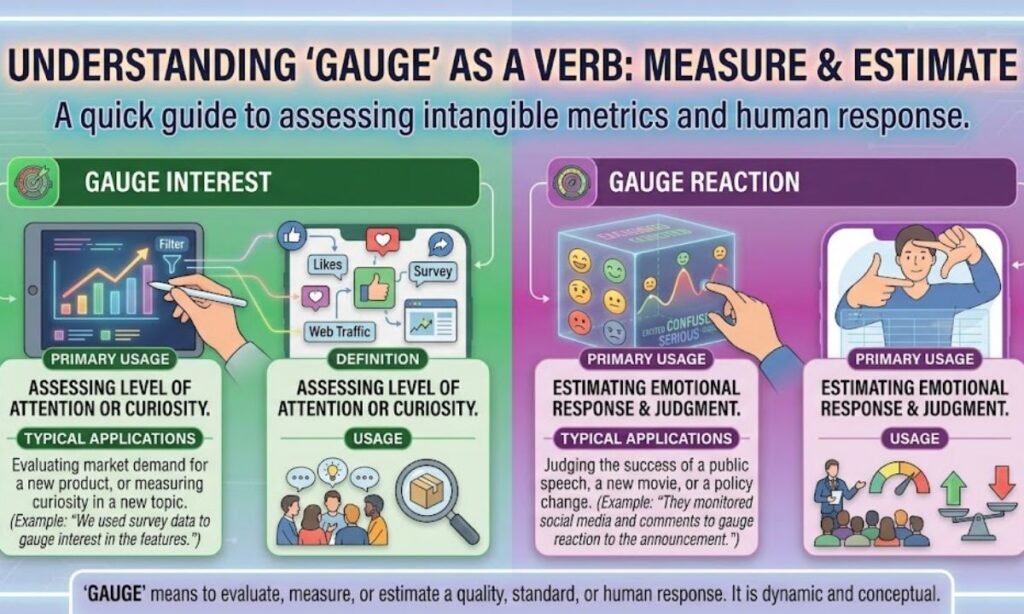
Many people search for this because the verb sounds unfamiliar. To gauge means to judge or estimate something that is hard to measure exactly.
Common phrases:
- gauge interest
- gauge reaction
- gauge public opinion
- gauge the impact
- gauge progress
Examples:
- The teacher asked a few questions to gauge how much the class understood.
- Before launching, the team ran a small test to gauge demand.
- It was hard to gauge his mood from the email.
Writers almost never use “gage” in this verb sense. If you see “gage interest” in a draft, change it to gauge interest.
Common Measurements That Use Gauge
These everyday terms all use gauge as the standard spelling.
| Term | What it means |
| 12 gauge | A common size of shotgun bore |
| Wire gauge | A number system for the thickness of wire |
| Sheet metal gauge | A standard thickness for metal sheets |
| Needle gauge | The width of a medical or sewing needle |
| Knitting gauge | The number of stitches and rows per inch |
| Railway gauge | The distance between the rails of a track |
| Pressure gauge | An instrument that measures pressure |
| Fuel gauge | A dashboard display showing how much fuel remains |
In many of these systems, a higher gauge number can mean a thinner item, as in wire or needles. Shotgun gauge also runs in an unusual way, so check the specific system before assuming.
Common Mistakes With Gage and Gauge
Assuming “gage” is always wrong. It is not. It is an accepted variant in some technical fields and a real word with its own history.
Using “gage” in general content. A blog post, essay, or product page for a general audience reads more naturally with gauge.
Using “gage” for the verb. Incorrect: We need to gage customer interest. Better: We need to gauge customer interest.
Mixing both spellings in one document. Incorrect: Check the fuel gauge, then the pressure gage. Better: Check the fuel gauge, then the pressure gauge.
Ignoring a field’s standard terms. Some measuring tools, such as a “gage block,” carry the spelling in their official name. Keep the name as written when you refer to it.
Mistyping “guage” or “gauge” as “guage.” This is a very common typo. The correct order is g-a-u-g-e, with the “a” and “u” in that order.
Easy Ways to Remember the Spelling
Try one or two of these.

- Default to gauge. If you do not have a reason to use gage, gauge is the right call.
- Spell it in order: g, a, u, g, e. Say the letters out loud once, and the “au” sticks.
- Link it to a familiar word: Think of the “au” in “gauge” the same way you see it in “fault” and “cause.”
- Check the audience: General readers, students, and business writers expect gauge.
- Check the brand: If a product or standard uses gage, copy it exactly.
Mini Practice Quiz
Choose the best spelling, then check the answers.
- The fuel (gauge / gage) showed the tank was nearly empty.
- We ran a survey to (gauge / gage) customer interest.
- True or false: Gage is always a spelling mistake.
- Which spelling should you use in a general blog post?
- A shotgun of this size is called a 12 (gauge / gage).
- Which word can also mean a pledge in older English?
Answers: 1. gauge. 2. gauge. 3. False. 4. gauge. 5. gauge. 6. gage.
Frequently Asked Questions
What does it mean to gage something?
In everyday writing, it usually means the same as to gauge something: to measure or judge it. Because “gage” is a less common spelling, most readers will expect “gauge” in this sense.
When to use gauge and gage?
Use gauge in almost all writing. Use gage only when a brand, a field, or a style guide calls for it, or when you are writing the older word for a pledge or someone’s name.
Do you gage or gauge interest?
You gauge interest. This is the standard phrase, and it means to estimate how interested people are in something.
Is it 12 gauge or gage?
It is 12 gauge. This is the usual spelling for the shotgun measurement, in American and British writing alike.
Is gage a real word?
Yes. Gage is a real word. It is a variant of gauge in some technical settings, an older word for a pledge, and also a name.
Final Verdict: Gage or Gauge?
Write gauge unless you have a clear reason not to. It covers measuring tools, measurement standards, and the verb meaning “to estimate.” Treat gage as a specialist spelling for certain technical fields, brand names, history, and names of people. Pick one form for your audience, stay consistent, and your writing will look polished.
Pingback: Parents or Parent’s or Parents’: Which Is Correct?
Pingback: Wich or Which: Which Spelling Is Correct?