
You ask where everyone wants to eat, and one friend answers with three letters: “idc.” Is that a shrug, a mood, or a tiny insult? Getting the IDC meaning in text wrong can turn a harmless reply into an awkward silence. The abbreviation looks simple, yet tone changes everything. A relaxed “idc, anywhere works” feels nothing like a cold “idc.” This guide explains what it means, how to read it, and how to respond without starting drama.
What Does IDC Mean in Text?
IDC is shorthand for “I don’t care.” People use it to save time when typing, and it shows up in texts, group chats, comments, and direct messages. It is almost always written in lowercase, with or without punctuation.
Because it is so short, IDC carries very little context on its own. That is why the same three letters can sound relaxed in one conversation and cold in another.
Here is a quick reading guide:
| What you see | Likely meaning |
| “idc, you pick” | I am happy with any choice |
| “idc about that anymore” | I have stopped caring about it |
| “idc.” (alone, after an argument) | I am done with this, or I am upset |
| “idc lol” | Casual, often joking or unbothered |
The Three Ways People Use IDC
Most uses of IDC fall into one of three groups.
1. No preference (friendly). The person is easygoing and lets you decide.
- “idc where we eat, I’m open to anything.”
- “idc which movie, you choose.”
2. Not interested (neutral to blunt). The person does not care about the topic.
- “idc about the game tonight.”
- “idc what the weather is, I’m staying home.”
3. Dismissive or upset (negative). The person is annoyed or shutting down the conversation.
- “idc what you think.”
- “fine. idc.”
The first use is the most common among friends. The third is the one that causes problems, because a short reply with no friendly words can feel sharp.
Is IDC Rude?
It depends on context, tone, and who you are talking to.
IDC is not rude by default. When someone says “idc, any pizza works,” they are being flexible. The same word after “Can you please listen to me?” is clearly harsh.
Signs that IDC is friendly or neutral:
- It comes with extra words (“idc, up to you”)
- There is a smiley, “lol,” or a casual tone
- The topic is low stakes, such as food or movies
Signs that IDC is dismissive:
- It is the entire reply
- It comes during an argument or serious topic
- The person has been short or quiet throughout the chat
A common mistake is reading tone into a message when the sender just types quickly. Before you take offense, look at the person’s usual style. If they text in short, flat replies all the time, a lone “idc” may mean nothing more than “any option works.”
IDC vs IDK: What Is the Difference?
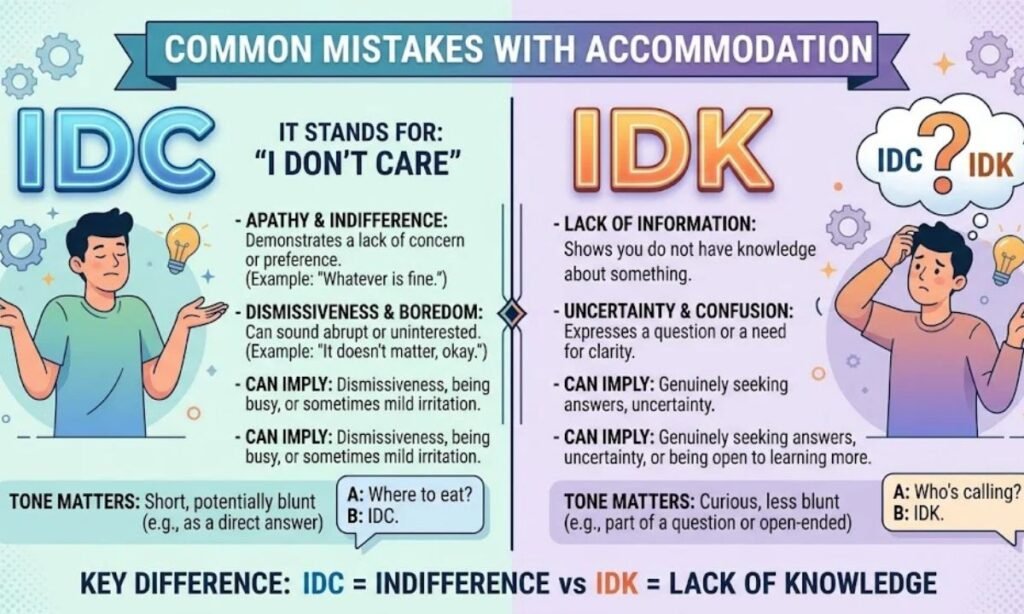
These two abbreviations look alike but say different things.
| Abbreviation | Stands for | Meaning | Example |
| IDC | I don’t care | No preference or no interest | “idc, you decide.” |
| IDK | I don’t know | Not sure or no answer | “idk where it is.” |
A simple way to separate them: IDK is about knowledge, and IDC is about feelings. If someone does not have the answer, they say idk. If they do not mind or do not want to engage, they say idc.
Mixing them up can change the whole message. “idk” invites help. “idc” often closes the conversation.
IDC Examples in Real Conversations
Seeing the phrase in context helps you read it faster.
Choosing dinner (friendly) A: “Pizza or tacos?” B: “idc, both sound good.”
Planning a weekend (casual) A: “Saturday or Sunday for the hike?” B: “idc, whichever works for you.”
Sharing an opinion (neutral) A: “Did you see the new trailer?” B: “idc, I’m not really into that series.”
Serious conversation (dismissive) A: “I really need you to hear me out.” B: “idc.”
Group chat (joking) A: “Who is bringing snacks?” B: “idc as long as there’s chips lol”
Notice how the extra words in the friendly examples soften the message. The shorter the reply, the colder it can read.
Common IDC Variations in Text
People often attach extra words to change the tone.
- idc tbh: “To be honest, I don’t care.” Often blunt but not always angry.
- idc lol: A relaxed or joking version. It can also hide real annoyance, so check context.
- idc anymore: I have stopped caring. This one can sound hurt or tired.
- idc either way: I am fine with both options. Very friendly.
- idc about that: I am not interested in that topic.
- idc what they say: I will not be swayed by other people’s opinions.
- idgaf: A stronger and ruder version. It is not suitable for polite conversation.
IDC on WhatsApp, Snapchat, Instagram, and TikTok
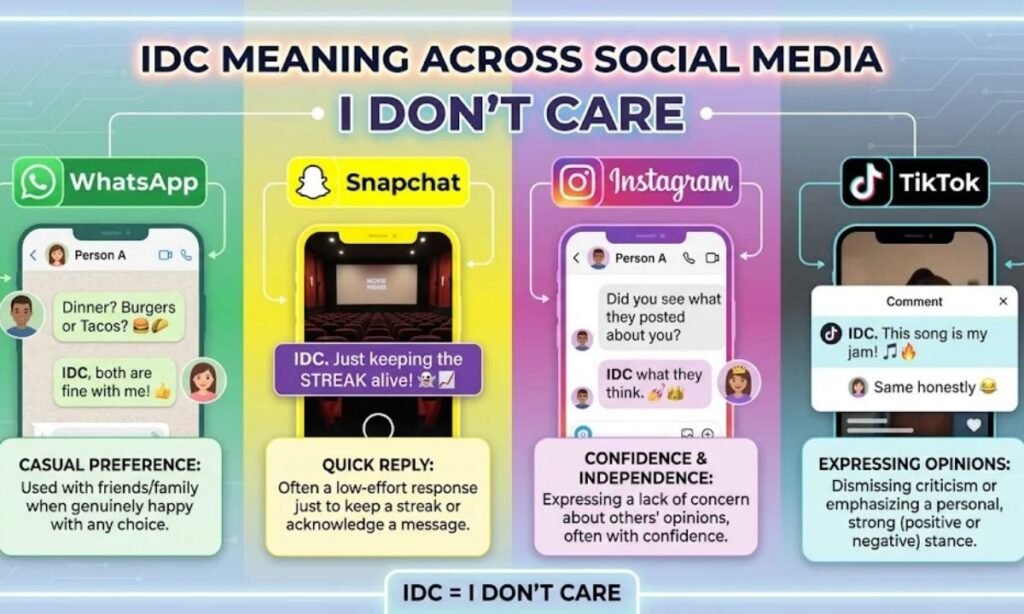
The meaning does not change across apps. IDC means “I don’t care” everywhere. What changes is the style of the conversation.
- WhatsApp and iMessage: Usually private chats, so IDC often means “no preference.”
- Snapchat: Fast, informal replies, so IDC is common and usually casual.
- Instagram and TikTok comments: Public replies, so IDC may come across as dismissive, especially in arguments.
- Group chats: IDC often signals flexibility when someone asks for a vote.
If you are not sure how a message will land, add a few friendly words or an emoji.
How to Reply When Someone Texts IDC
Your best response depends on what they mean.
If they have no preference: Make a decision and keep things moving.
- “Great, then let’s go with tacos.”
If they seem upset or distant: Check in gently instead of reacting to the tone.
- “You okay? Want to talk about it?”
- “Sounds like this is not the right moment. We can pick it up later.”
If they dismiss your point in an argument: Stay calm and name what you are noticing.
- “It feels like you’re done with this talk. Should we pause?”
If you are unsure: Ask a simple question.
- “Do you mean you’re flexible, or are you annoyed?”
A short, calm reply usually works better than matching the same tone back.
Polite Alternatives and Professional Use
IDC is casual slang, so skip it in emails to a boss, teacher, or client. It can come across as careless or cold in formal settings.
Better options:
| Instead of | Try |
| idc | I’m flexible. |
| idc, you pick | Either works for me. |
| idc about that | That’s not a priority for me right now. |
| idc what they think | I’m not worried about other opinions. |
| idc anymore | I’ve moved on from this. |
These alternatives keep your message clear and respectful. They also leave little room for misreading.
Does IDC Have Other Meanings?
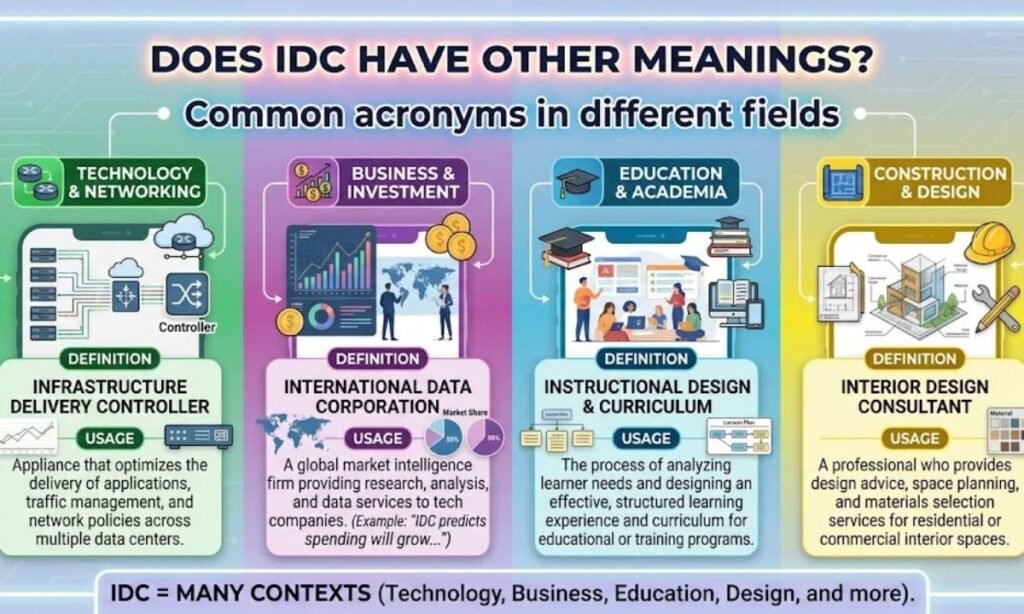
In text messages, IDC nearly always means “I don’t care.” Outside of texting, the same letters can stand for other things, depending on the field.
- International Data Corporation: a market research firm in the technology industry
- Invasive ductal carcinoma: a medical term for a type of breast cancer
- Internet data center: a facility that hosts servers and network equipment
You will rarely see these in chats. If the topic is business, health, or technology, check the context before assuming.
IDC does not mean “I don’t mind” in a strict sense, though people often use it that way when they have no preference. The closer meaning is “I’m fine with whatever.”
Frequently Asked Questions
What is IDC in Gen Z?
It means “I don’t care.” The abbreviation is common in casual chat among younger users, but it is not limited to one generation. Many people use it in the same way.
Is IDC a rude word?
Not always. IDC is neutral when it means “I have no preference,” and rude when it shuts someone down. Tone, extra words, and context make the difference.
What is an IDC person?
There is no official definition. Informally, it describes someone who often says “idc,” meaning a person who seems relaxed or uninterested in making choices. Whether that is positive or negative depends on the situation.
What is IDC in WhatsApp?
It means the same thing as anywhere else: “I don’t care.” On WhatsApp it is usually used in private or group chats to show flexibility or disinterest.
What does “IDC lol” mean?
It usually means “I don’t care,” said in a light or joking way. The “lol” softens the tone, but it can also cover up annoyance, so read the rest of the conversation before deciding.
Final Takeaway
IDC stands for “I don’t care,” and its tone depends on context. Among friends it often means “I’m easy, you pick.” In a heated chat it can mean “I’m done.” Look at the words around it, the topic, and the person’s usual style before reacting. If you use it yourself, add a friendly phrase when you want to sound relaxed instead of cold.
Pingback: Forth or Fourth: What’s the Difference? Meaning & Examples