
You are writing a caption for your zoo photos, and the sentence stops you cold. Monkeys or monkies? You type both, stare at them, and now neither looks right.
It happens to plenty of careful writers, because English plurals love to change the ending of a word. The good news is that this one follows a simple rule, and it takes less than a minute to learn. Here is the right spelling, the reason behind it, and how to avoid similar slips.
What Is the Plural of Monkey?
The plural of “monkey” is monkeys. You simply add an “s” to the end. Nothing else changes.
This works the same way in American English, British English, Canadian English, and Australian English. There is no regional variation, so you never need to adjust the spelling for your audience.
Here are a few quick examples:
- One monkey sat on the branch.
- Two monkeys sat on the branch.
- The monkeys’ cage was clean. (possessive plural)
“Monkey” is a countable noun, so it takes a plural form and works with numbers: one monkey, five monkeys, a hundred monkeys.
The Spelling Rule Behind Monkeys
English has two different rules for words that end in “y.” Which one applies depends on the letter right before the y.
| Letter before the y | What to do | Example |
| Vowel (a, e, i, o, u) | Add -s | monkey → monkeys |
| Consonant (any other letter) | Change y to i, add -es | baby → babies |
In “monkey,” the letter before the y is e, which is a vowel. So the word follows the first rule and becomes “monkeys.”
Now compare it with “baby.” The letter before the y is b, which is a consonant. That is why “baby” becomes “babies,” while “monkey” does not become “monkies.”
The vowel in front of the y protects it. The y stays as it is, and the “s” goes on after it.
Why Does “Monkies” Look Right to So Many People?
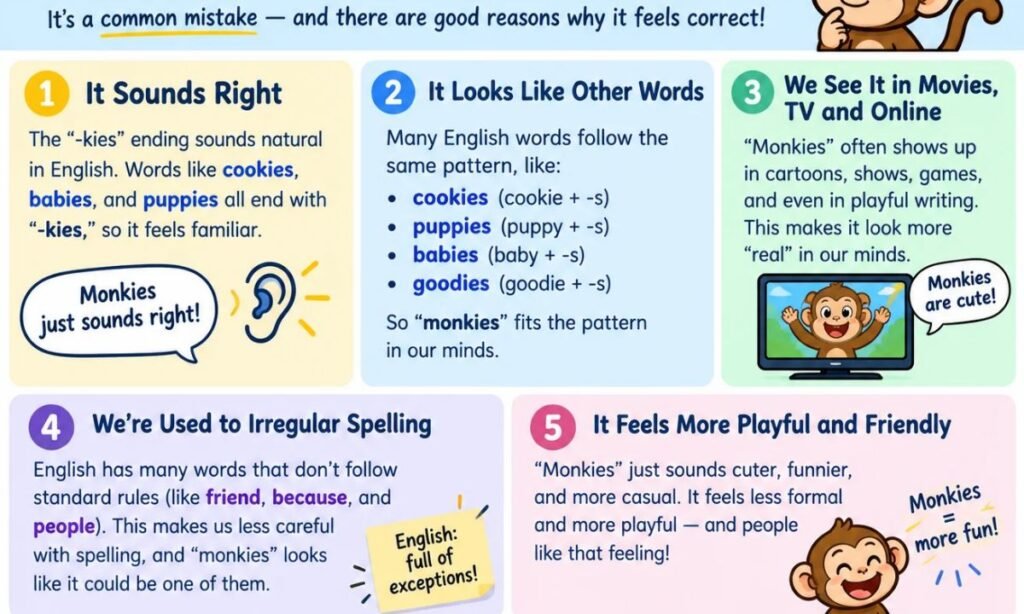
Nobody makes this mistake out of laziness. It happens for a few understandable reasons.
- Pattern overload: Many common words, such as “baby,” “city,” and “party,” change to “-ies.” The brain applies that pattern too widely.
- The sound: “Monkeys” sounds like it ends in “-eez,” which feels like the “-ies” ending.
- Visual habit: People see “-ies” so often that it starts to look normal on any word with a y.
- Autopilot typing: Fast typists reach for the familiar pattern without thinking.
The fix is to check one letter. Look at what sits directly before the y. If it is a vowel, keep the y.
Words That Follow the Same Pattern as Monkey
“Monkey” is not special. Dozens of words end in a vowel plus y, and they all just add an “s.”
| Singular | Correct plural | Common mistake |
| monkey | monkeys | monkies |
| donkey | donkeys | donkies |
| key | keys | kies |
| turkey | turkeys | turkies |
| valley | valleys | vallies |
| journey | journeys | journies |
| boy | boys | boies |
| day | days | daies |
| toy | toys | toies |
Once you see the pattern, you can spell any of these without stopping to think. Words ending in -ey, -ay, -oy, and -uy all work this way.
Words That Do Change to -ies
To avoid overcorrecting, it helps to know which words really do use “-ies.” These all end in a consonant plus y.
| Singular | Correct plural |
| baby | babies |
| city | cities |
| story | stories |
| party | parties |
| family | families |
| lady | ladies |
Notice that every word in the table has a consonant right before the y. That is the whole difference.
A Few Exceptions Worth Knowing
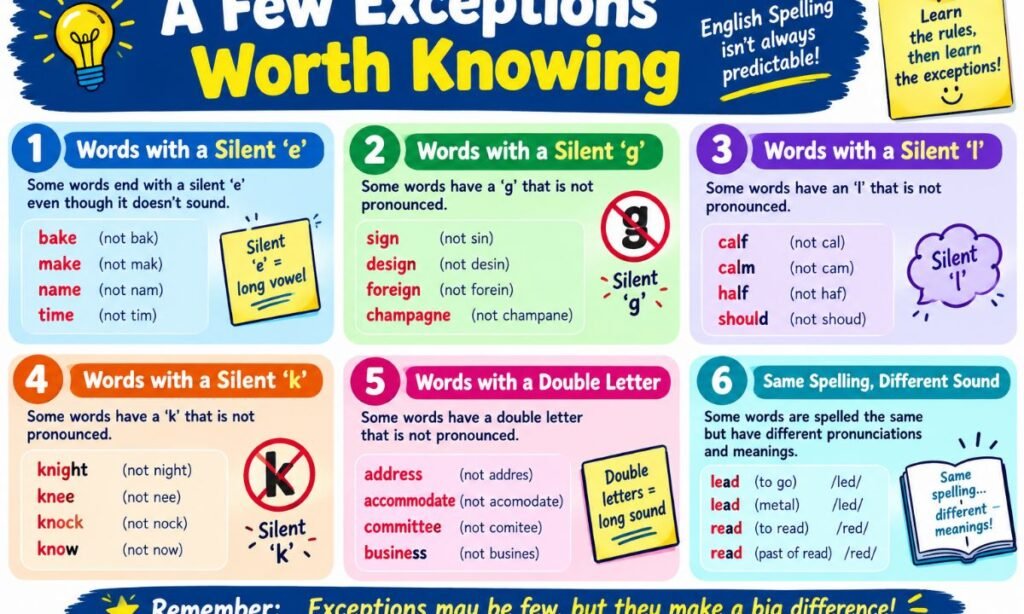
English likes to keep us on our toes, so here are the small exceptions.
- Proper names: Names usually just add “s,” even when they end in a consonant plus y. For example, we write “the Kennedys” and “the Harrys,” not “the Kennedies.”
- Money: Both “moneys” and “monies” appear in finance and legal writing. “Monies” is a special case and should not be used as a model for other words.
- Compound words: A word like “lady-in-waiting” changes the main noun, so it becomes “ladies-in-waiting.”
None of these affect “monkey.” It stays simple: monkeys.
Monkeys in Real Sentences
Here are examples you can borrow for school, work, or writing.
Everyday use
- The monkeys at the zoo were fed at noon.
- She watched two monkeys groom each other.
- We saw wild monkeys on the trail.
Possessive forms
- The monkey’s tail was long. (one monkey)
- The monkeys’ enclosure was closed for cleaning. (more than one)
Common phrases
- A barrel of monkeys is a phrase for a lot of fun, often used with the classic toy game.
- Monkey business means silly or dishonest behavior.
- Monkeying around means playing or messing about.
- Three wise monkeys refers to the famous image of the monkeys who see no evil, hear no evil, and speak no evil.
Monkeys vs. Apes: A Quick Clarification
Many people mix up the animals, so the words get mixed up too. Monkeys and apes are different groups of primates.
- Monkeys usually have tails and include animals such as macaques, baboons, and capuchins.
- Apes do not have tails and include gorillas, chimpanzees, orangutans, and gibbons.
The plural of “ape” is also simple: apes. The word “monkeys” should not be used for animals that are actually apes, though everyday speech often blurs the two.
What Do You Call a Group of Monkeys?
A group of monkeys is called a troop. You will also see the playful phrase “a barrel of monkeys,” but that is mostly a figure of speech.
Example: A troop of monkeys crossed the road.
In a sentence, “troop” is singular, but “monkeys” is the plural noun that follows it. Keep the spelling clean in both parts.
Easy Ways to Remember Monkeys
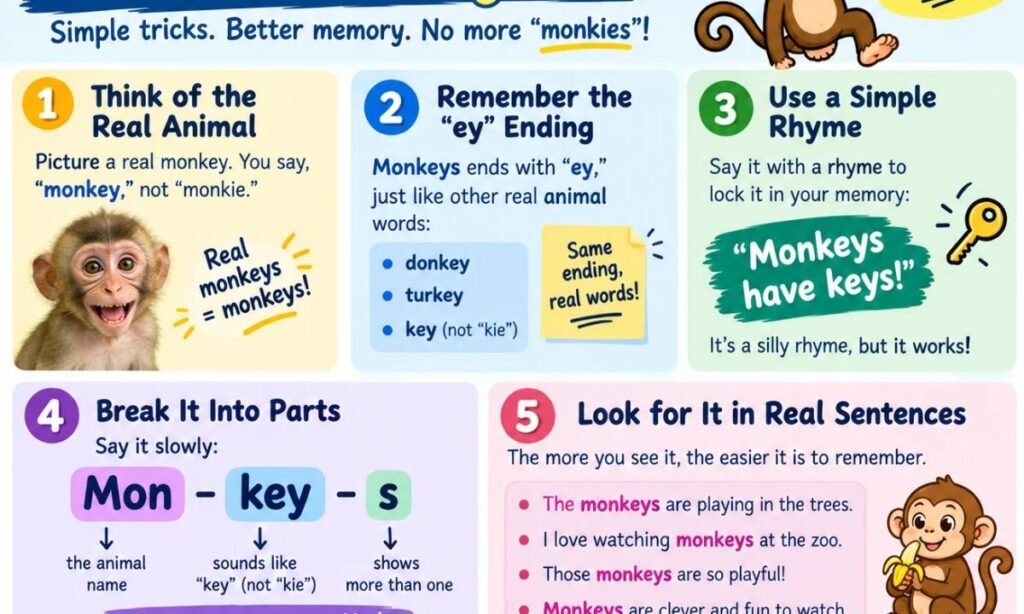
A few small tricks make the spelling automatic.
- Check the letter before the y. If it is a vowel, keep the y and add “s.”
- Pair it with “donkeys.” If you would never write “donkies,” you should not write “monkies.”
- Picture the keys. “Key” becomes “keys,” and “monkey” ends the same way.
- Say the rule once. “Vowel plus y, just add s.”
- Ask whether it is a baby. Only words like “baby” and “city” swap the y for “ies.”
FAQs
What is the plural of monkey?
The plural of monkey is monkeys. Because the letter before the y is a vowel, you only add an “s.” The spelling is the same in American and British English.
Is “monkies” a word?
No. “Monkies” is not a standard English word. It is a common misspelling caused by applying the “baby to babies” rule to a word that does not follow it.
Is a monkey countable or uncountable?
“Monkey” is countable. You can say one monkey, ten monkeys, or many monkeys. It has a regular plural form and works with numbers.
What are baby monkeys called?
A baby monkey is usually called an infant. In everyday speech, people also say “baby monkey.” There is no single special name used in all contexts, so either form is fine.
Conclusion
The answer to “monkeys or monkies” is clear. Monkeys is correct, and “monkies” is a spelling mistake. The reason is a simple rule: when a word ends in a vowel plus y, you add “s” and leave the y alone.
Keep that one rule in mind, and you will also spell “donkeys,” “keys,” and “journeys” correctly. Save the “-ies” ending for words like “baby” and “city,” where a consonant sits before the y.